Showing posts with label SDi. Show all posts

Monday, March 31, 2025

Belden 4505R (and other "12G-capable") coax cables

12G SDi over coax is a hard problem to solve; my normal practise is to not run 12G over distance (you can find all my original figures for measuring verious cable types here) - in fact anything much past twelve metres and you become very dependent on the quality of the sending and receiving equipment. Best practise is once you've left the MCR you should be running it over single-mode fibre. 

Anyway, you see people claiming things online "I've heard you can can run 12G 50m using this kind of cable etc etc" but even the most expensive coax using all the tricks (Nitrogen-inflated dielectric etc) can't defeat physics and any transmission channel has a bandwidth/distance product. Testing I did with Belden 1694A showed it can reliably carry 3G to about 60m and so since 12G is two octaves more bandwidth down similar quality cable it will go a quarter of the distance.

Of course you may be able to do better with Sony, Tektronix, Barnfind, or Leader gear at each end, but most people are using Blackmagic etc. with the associated poor return-loss.

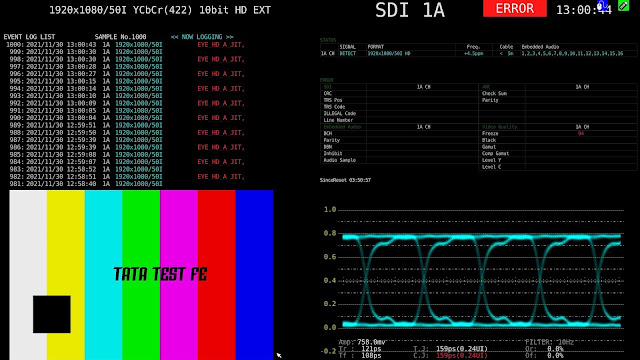
So, here are some test results using a Leader LV5600 with 12G physical layer measurements and test signals. The cable is Belden 4505R (data sheet) which is Belden's best spec'ed high bandwidth 75ohm coax (with a price to match!) and yes, I did use the 12G BNCs and the correct crimp tool...!

Interesting to note that they do not specify maximum distance to stay inside SMPTE-2082, but they do mention that at 12Ghz the cable attenuates at just less than 1dB per metre - if that doesn't tell you what you need to know...!

5m

10m

15m

30m


Friday, December 31, 2021

SDi physical layer measurement for 3G and 12G; a video presentation.

In the last couple of months I've had to do both training and fault-finding for SDi physical layer measurements. Below is a cut-down video of the half-day training; just so you can get feel for my training style.


I've also been working for a sports broadcaster tracing a problem they have with their incoming OB lines (all via a telco's private cloud J2K SDi route) - the problem was more fundamental than you'd think, but I got to the bottom of it.

I'm very pleased to have a Leader LV5490 with the physical layer measurement option; I can just rock-up at a clients and within minutes be able to give them proper eye measurements with jitter (both 10Hz wander and 10/100KHz-filtered readings). 


Wednesday, October 05, 2016

HDMI, HDCP and SDi out from Bluray players

It's been a few years since the master HDCP key escaped into the wild and so it seems that particular content protection system is fundamentally wounded (if not dead!) but reputable manufacturers still respect the HDCP flag (even if no encryption is present) and the MPAA are still issuing device keys to manufacturers and volume keys to content producers.
So - I have been installing some Oppo Bluray players (nice, high end machines) and they support HDCP rather too aggressively; on a non-compliant display you don't even get the boot screen or any menus! So - an SDi converter is out of the question. 
The usual trick is to use one of these cheap'n'cheerful HDMI splitters which present a device key to terminate the signal but then send it to two outputs having done the decryption. 


Works perfectly with Backmagic HDMI->SDi converters with the exception of the audio; the Blackmagic knows nothings about DTS+ or DolbyDigital (or any of their variants) - it only understands the basic PCM stereo part of the bitstream and so that's what you get in the SDi stream.

However - in the case of these Oppo 103D players they have decoders on board and present the de-compressed audio out of the back as good old analogue feeds;

In these rooms I've fed them to the analogue inputs of the Tektronix WVR8200 test set and hence by selecting a different audio input you can toggle the TC Electronix ClarityX controller between 7.1 from the Avid and surround sound from the Oppo.

Tuesday, June 10, 2014

HD/SDi physical layer measurements - gotta be Tektronix

Here's a brilliant document from Tek - tell you all you need to know about eye pattern, jitter etc.
http://www.tek.com/document/how-guide/sdi-eye-and-jitter-measurements...

Wednesday, December 19, 2012

3G SDi parts becoming commodity?


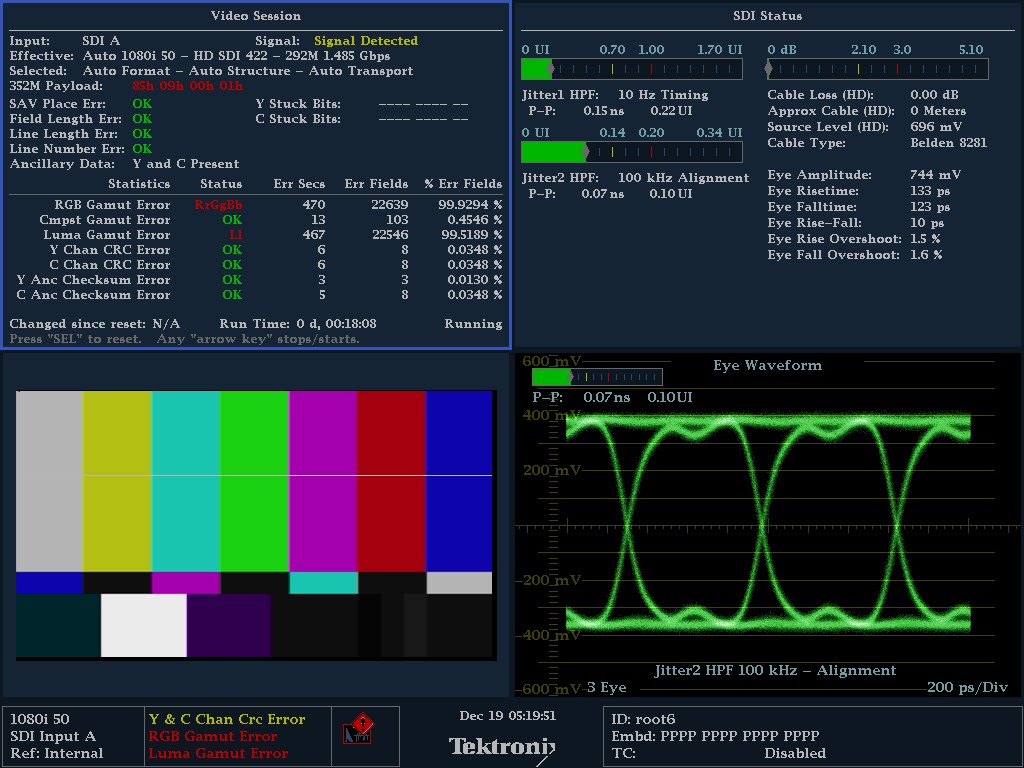
My pals at Lindy (who I buy lots of computer connectivity parts from) sent me a bunch of engineering samples of 3G-capable SDi parts; DAs, fibre transceivers etc. from one of their OEM manufacturers in the Far East. For very modestly priced pieces they were excellent. The eye-pattern (above) is the output of their re-clocking DA. Whilst talking to them about the various measurements I made (which you'd only understand if you're a broadcast engineer) I recalled Tektronix's excellent SDi physical layer webinar and pointed the guys at it. 

 http://www.tek.com/webinar/hd-and-3g-sdi-physical-layer-webinar