Showing posts with label bbc. Show all posts

Monday, March 13, 2017

Calibrating monitors for HLG-1.2 High Dynamic Range working

I've now done a couple of Sony BVM-X300 (4k/HDR OLED panel) monitors for HDR-TV deliverables to the BBC. The Beeb are behind the Hybrid Log Gamma standard, currently at 1.2 for broadcast. It's benefits over Dolby's 10-bit version of their Vision HDR system (also called DolbyPQ) are many and rather splendidly the DVB as well as most manufacturers are now behind HLG. I'll write further about why a scene-referred system is a better bet for domestic TV than a display-referred one (like DolbyPQ) but I just wanted to get down some notes on monitor calibration for HLG.

So first up you need to get the monitor into HDR mode (the correct one! As of v.2 firmware the X300 supports several; the camera gammas; CLog, CLog2, SLog & SLog3 as well as the deliverable standards; SMPTE-2084 (DolbyPQ) as well as SMPTE-2100 (HLG 1.2).


You'll notice the EOTF setting (lit. "Electronic - Optical Transfer Function") is NOT set for HLG 1.2; this available but in the current v. 2.0 firmware it is wrong. Select HLG (Variable), click the know again and dial in 1.2

Next up display a 50% grey field (100% can't be done as the monitor power-limits to stop 1,000Cd/m2 being displayed across a lot of the screen) and point your probe at the display. Remember that unlike DCI-P3 we are still at the 6504K white point of tele. However - at 50% grey we should be seeing low-50's Cd/m2 being emitted from the screen. 


You might have previously heard Sony's "best practise" (sic) advice of setting 50% grey to 100Cd/m2 but this is wrong. Look at the graph; this is the result of profiling an X300 (and they all seem to do it consistently) and notice what happens over the last couple of hundred Candelas at the top end. If you set 50% grey to 100Cd/m2 you get loss of detail in the specular highlights. For the correctly 1.2 HLG curve you need to set 50% to around 50Cd/m2 to 55Cd/m2- remember the Y-axis on this graph is logarithmic. 

The one display I had previously followed the Sony advice for was sufficiently out of it's linear range that the dark-greys drifted red minutes after I finished adjusting the monitor and (like all OLEDs) the noise in their blacks is sufficient to make the final tweak to 6504k hard work - the Klein probe was having to average over 32 reads to accommodate the OLED panel. Remember - the K10A is accurate to less than 0.001 Cd/m2 and not the 1.0 Cd/m2 it reads at 10% up the curve of HLG 1.2

So - once you have those under your belt you can PLUGE the display to set blacks correctly for the room (what did I say about scene/display referred?!) and then set about getting the deep greys and the 50% colour balance correct. I've done this now on two X300s with BBC R&D engineers in attendance and they have given this method their blessing!

For a probe I was using a Klein K10A with Klein's own ChromaSurf software. If I get the chance to profile an X300 for myself I will do it with LightSpaceCMS - still the choice of champions for display profiling and LUT-building. They also have an excellent article introducing HDR.

Saturday, May 25, 2013

Failure of the BBC's "Digital Media Initiative" and other large IT projects

I still describe myself as a Broadcast Engineer rather than a project manager - and in fairness I do spend more time looking at cable-schedules and schematics than Gantt charts. However; I am often responsible for other people's money in achieving what they want in TV and data facilities. Compared to the BBC DMI project the largest project I've had overall financial responsibility for came to a bit more than 1% of the size of that gig so I am in no means an expert. However - I have worked for dozens of large and small broadcasters and I think I've seen some of the best and worst aspects of other people's project management styles.
I feel sorry for John Linwood - the BBC's CTO who has been suspended over the whole debacle. It's telling that the Beeb now have a CTO rather than a Chief Engineer as that latter term implies that you've had a career in broadcast engineering - you've calibrated monitors, fixed studio cameras (and then racked them in live productions), installed Media Composer (and supported the editors), replaced the head-drums in VTRs as well as the myriad other bits of experience that the top technical job at the world's most prestigious broadcaster would imply. John is a similar age to me and so I'd expect him to remember mk.2 telecines, tubed cameras and 1" VTRs but he's a software guy; ex-Yahoo, ex-Microsoft and it's there you'll find both the justification for him being the Beeb's top technical guy and the reasons for the pickle he's now in. The DMI was a software project BUT software projects have a huge propensity to fail. Around 30% of software projects in commercial industry fail - but that's OK; you have to take risks and great things don't come if there wasn't a danger of failure (that's why it's a risk!). However - in government IT projects the risk of failure is an awful lot higher - typically 70% for publicly-funded IT projects. You'd expect project manager who are being paid with tax-dollars to be more risk-averse but the opposite seems true. Clearly this has been the case at the BBC with the DMI. 
Ross Anderson has written extensively about this kind of thing; he did an interview with Stephen Fry on Radio 4 a couple of years ago which makes a lot of these points; as an aside his brilliant book "Security Engineering" is now in the public domain.

Here are a few thoughts on big-organisation technical projects;
  • The danger of "not invented here" - when I was at the BBC most custom projects (i.e. equipment and solutions not bought in from external manufacturers) were often specified and implemented by Research Department. In fact too many projects were as there was an attitude of "nobody understands what we do except us" and so consequently too many things were done by people who might be doing it for the first or second time (chief engineers of facilities will have designed/built maybe two or three machines rooms in their twenty year career - I've done it dozens of times in the last decade!). 
  • "Gold plating" everything - In the late eighties/early nineties there was a guy in BBC Research Department who liked the DEC MicroVax 3100-series running VMS (at the time it was a £35k industrial computer) and so whenever a project needed an external computer we'd see a MicroVax appear in the machine room. Automated upload of new weather symbols to the Quantel Paintbox - throw a MicroVax at it. Download realtime financial data from Reuters to make the Aston strap for the breakfast news financial segment; control the caption generator with a MicroVax! However - when it fell on the maintenance department to make something work they typically used a BBC Micro (we all had them at home and new how to program/homebrew them) - the ASTED project to control external logo generators and make them work with the Aston caption machine for news programmes was all done via a £350 BBC Micro, not a £35k MicroVax.
  • In a similair vein I had a friend who was working on the NHS unified records system for EDS - he spent eighteen months working on a new secure-VPN protocol; that's not a problem that needs solving! That one is already done with a choice of closed and open-software solutions.
  • Don't despise project management methodologies. Lots of engineers have a distrust of Prince2 and it's ilk and for sub-£1m projects the overheads are too onerous, but there are so many valuable lessons that proper project managers bring. In a recent discussion with a colleague about how one project had turned quite painful we realised that the PM101 principle of fully involving the users had been almost totally missed by the customer and it was proving hard to get the poor editors and assistants to buy-into the new system once they saw the implementation.
  • "Good, Fast, Cheap - choose only two" - this is the warning PMs often give and it's regarded as customers as a prohibition rather than a good principle to run a project by. The tension of having to hold those three ideas and adjust the sliders as necessary means you don't push them all to the max and expect the best outcome. If they had regarded this principle there is no way they would have let the thing drag on for five years. Timely projects are the best kind.
  • Specify, specify, specify - the more you leave to fortune or to the contractors' discretion means you have too many undefined problems.
  • Don't disregard experience - the engineer who taught me all I really know about broadcast SI - Chris Clegg - had one thing he used to say about designing facilities; "...given a crew of qualified operators they should be able to run this studio/OB truck/machine room with only fifteen minutes instruction from the usual operator". You can't do that without intimately understanding how TV workflows interact with facilities and how operators and assistants operate. The point is that the best broadcast project managers have years of experience in those areas. Professional project managers (who aren't experienced engineers) don't have those insights.
One thing I can't understand is why Siemens were initially given the project; are they renowned for any of the things that were trying to be achieved? - big database, large video storage, transcoding, version management and the underlying filesystem to make it all hang together? Given that it also has to work with your editing, transmission, and VOD platforms why on Earth not get Avid, Isilon, Google etc involved; OneFS for the backend and GFS for the database sound like they were designed for this (and they also run most of the big Internet media sites).

It'll be interesting to see if the BBC takes on an experienced engineer as their next CTO.

Monday, March 25, 2013

The end of Television Centre - what's changed since I was there?


I joined the Beeb in 1988 and spent the first five years of my career in and around TV Centre. My first BBC posting was to Lime Grove studios (which was a few hundred metres behind the centre) with the occasional foray up to Studio 2 to do camera control on Newsnight. 
Although it's now twenty years since I worked for the BBC I still hold the corporation in great fondness for training me and always encouraging best practice from an engineering point of view. I don't think I could have had a better start in the industry. I honestly believe the BBC is a civilizing force and an example of just how good and truthful a broadcaster can be. They are without equal in my view.

Anyhow - just a few notes on how things have changed since 1988;

Videotape - 2", 1" and 1/2" BetaSP (just coming in) and UMatic or even VHS for offline and viewing copies. Since I worked in news some footage arrived on UMaticSP - BVU900 style.

Digital Video - when I started there was very little equipment that was digital; even less so that was run by a microprocessor. PCs were never seen as everything was built for the purpose (and cost £100k as a consequence!). Aside from D1 videotape (that was still very much being demo'ed at trade shows) you found digital video inside equipment, not used to interconnect it;
  • TBCs - Timebase Correctors for analogue videotape - typically a few lines of 4Fsc storage
  • Frame Synchronisers - used to time free-running incomming feeds into a studio
  • DVEs - typically three frames of storage that would allow you to re-size or at best 'curve' a video signal
  • Painting system - only Quantel Paintbox 7001 series at the Beeb but there were others - Spaceward Matisse was the competitor.
Audio - still mostly analogue recorded on 1/4" or 1" 24-track (Studer style). DAT was starting to come in and there was Sony F1 for sending stereo digital audio over a video channel. We also had SIS (Sound in Syncs) - a way of sending digital audio on a video signal. NICAM had just been launched (14-bit, 32Kits/sec companded to 10-bits = 728kbit/sec) - I hadn't heard of audio compression at this point!

Video Cable - at the BBC this was either PSF1/3 or PSF1/2 for long runs; oh, when we expected so little from coax!

Studios - This is a picture of Studio 2 from 1988
Notice the Grass Valley GVG-1600 vision mixer - it's the one you see in Star Wars in the Death Star controlling the destruction of Alderan!
Notice the VT100 terminal at the left hand side of the desk; that was connected to the BASYS newsroom network running on six PDP-11/84s (IIRC) and controlled scripts, the AutoScript prompters and even gave us all email.
The DVE was a Quantel 5000 that occupied a whole equipment bay!

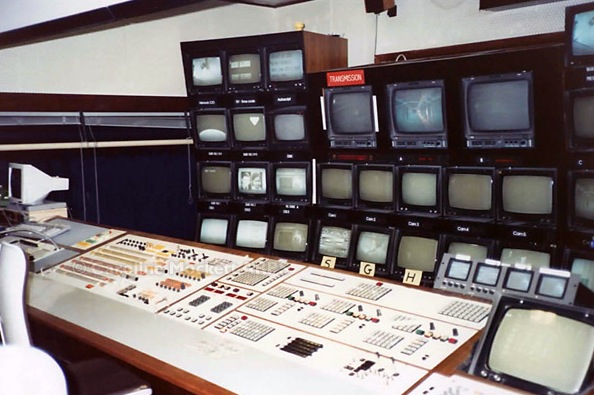
Cameras - they were all tube cameras when I started with the attendant headache calibrating them for a studio shoot and they required two engineers to control them - one for the "racks" (blacks and whites) and one for colour control (referred to in the Beeb as "knobbing" - I did that a lot!). The cameras shown here are a pair of Link 110s from my time at Line Grove. We had Link 125s in TC2 - they were all a nightmare! When I moved to Carlton in 1993 I was amazed how good the Sony BVP-7 CCD cameras were to line-up and control.

I don't have a whole load of photos from the time; we didn't have cell 'phone or digital cameras and I have a feeling it wasn't considered good manners to take photos at work. I do have a picture from 1992 from the big wall of Stage 5 (which was under construction pretty much the whole time I was in News VT maintenance in the Spur).

This wall was subsequently obscured by Stage 6 which was built in the nineties.
In summary there is no other place a trainee engineer could get experience of:
  • Studios
  • Post Production
  • Outside Broadcast
  • Telecine
  • Transmission

Trainee engineers of 1988!


Tuesday, October 27, 2009

A Eng Funds no.21 September 1988


Another BBC photo from a couple of decades ago! There's me in the back row. Mark Chambers (rear left) and I shared a flat - he worked in OBs at Kendal Avenue. Tim Cowin (between me and Mark) worked in Radio and Jim Binks (below Tim) now works at EMS.
Anyone else you know?

Sunday, October 25, 2009

Electronics Graphics area from 1991


I was going through some old photos from work - this is BBC White City's first electronic graphics suite - you can see a couple of original series Quantel Paintboxes (the 6U one with the brown front panel that looked like every other Quantel box of the eighties!), Sony DXC3000 camera (their first broadcast CCD model), Questech Charisma (two channels, IIRC - not the curvy effect model), Abekas A64 disk recorder (sixty seconds of video!), Ampex Ace 200 edit controller, three BetaSP decks and a Revox 1/4" tape machine.
This was the first area I had a hand in - possibly my start in Systems Integration. We had the DVE, Quantels and A64 hooked up to each other over a 4x4 601 matrix - 8 bit digital video over 25-pin D-types so it was possible to do lossless bouncing between those gadgets.

Thursday, July 10, 2008

Joe was on Question Time


The Schools Question Time programme is the final product of a far wider education initiative to help schools nationwide by supporting the citizenship curriculum, helping improve students' public speaking and listening skills and engaging young people in society and politics.

Schools across the UK, with pupils aged 14-19, were eligible to enter the challenge.

Friday, April 18, 2008

Memories of Lime Grove

I was recently supervising a job in White City and took a lunch-break to wander around the market and down to Lime Grove (the first studios I worked at when I joined the Beeb in the eighties). Of course it's all been redeveloped as housing but it was nice to see the fashion college and primary school across the road.

Martin Kempton's site is excellent and will easily kill an hour of work-time! See his pages on Television Centre.

The move of the VT department to stage 5 did not take place immediately. They had to wait for a new tape format to be established before equipping all the suites. This format was the D3 cassette. Developed by Panasonic, the BBC was its first major customer. A few suites were opened in 1991 and used for training but the big move to stage 5 happened in January 1992.

The BBC's post production department had been created in 1989 - combining film editing with VT editing and sound dubbing. This new department was, as its name suggests, more concerned with what happens to the programme after it has been made rather than during it. From 1991, the new D3 cassette enabled each of the studios to be equipped with its own machines which were (and are) operated by the studio resource manager.

Thursday, April 10, 2008

Couple of BBC iPlayer stories

BBC and ISPs clash over iPlayer
ISPs say the on-demand TV service is putting strain on their networks, which need to be upgraded to cope.
This is so rich - ISPs moaning about the fact that they have sold themselves short. Now the Beeb pay Akamai (and other peering partners, I'm sure) for every gigabit of iPlayer data that leaves White City and then I pay my ISP for my 4meg uncapped connection - currently £25 per month which I don't resent. The ISPs have peering arrangements with backbone providers so that they don't actually pay for aggregate bandwidth between those higher echelons of the internet. What it comes down to is that they have sold people on faster-than-they-are-willing-to-provide connectivity and now they have to stand by those promises.


BBC announces Nintendo Wii deal
The video download and streaming service that lets people catch up with BBC programmes will soon be a channel on the hugely popular game console.
Wow - what a fantastic coming-together of technology. You could have yourself an iPlayer set-top box for £180 (aside from the huge fun you get from the Wii) - that is the kind of things that will mean that video-on-demand will really penetrate and I'm thankful that it's the Beeb. After all they made DVB-T a reality in this country (ITV couldn't/wouldn't sustain OnDigital) and if this keeps Murdoch out of the space then so much the better.

Monday, February 11, 2008

Jack Johnson on BBC Radio 2's Music Club


Radio stations taking space on the tele! Whatever next? I culled this from the BBC Freeview interactive service a few weeks ago.

Tuesday, January 29, 2008

Where I lead the BBC follow!

I spent hours last year re-cutting episodes of Torchwood so that my kids could watch it - they are monster Dr Who fans and were devistated when they realised that the spin-off was going out after the water-shed. Anyhow - click the link in this entry's title for details of my workflow.
I was very pleased to see that the BBC are now doing it for me! By the end of season one I was knocking out a dozen DVDs per week to keep up with the demands of school friends!

Saturday, January 05, 2008

BBC iPlayer on my TV

Looking good - once again the beeb show the way. Colour TV, Teletext, Nicam, DAB, DVB-T, HD-television and now IP-TV.
The BBC have either introduced or made successful every innovation in broadcasting.
If you consider how they managed to turn around the fate of DVB-T (OnDigital becoming Freview) and how good their IP-TV offering is in the face of Channel Four and Five's offering you realise it is imperative that we have a BBC.

Thursday, March 29, 2007

Celebrities - just like the rest (or worst!) of us.

I was working in an edit suite recently and overheard a well known TV personality making a call to book train tickets. They wanted to go to Glasgow first class (hey, if you've got the cash why not travel in comfort?) but booking four tickets (around the same table) so that...
...I don't have to sit next to any common people

Now, this person has a column in The Independent and presents themselves as fair-minded, liberal, person-of-the-people in their writing/TV presenting!

One celeb I've got a bit of experience of is Jeremy Paxman - In the late eighties I was working as a maintenance engineer in BBC Television News and was doing the late shift one night (essentially what was the Nine O'clock News and then Newsnight) and was on the studio floor in Studio Two, BBC Television Centre trying to fix Paxman's 'cought-cut' (a button on a long cable that the newsreader keeps to hand to momentarily mute his microphone if he has a coughing fit). Not really noticing the time and my brain having long blanked out the seemingly unending re-cueing of the theme music over the studio's monitors I didn't realise that while scrabbling about under the programme desk the Studio Manager had counted the crew down for the live transmission. As I emerged from under the desk by Paxman's legs he put a gentle yet very firm hand on my head and pushed me back under the table-top and as he finished delivering his piece to camera introducing the first report on video tape he let go and said with a broad grin "you didn't know we were on the air, did you?" - what a gentleman! Not at all like the media-types I have to deal with nowadays.

Paxman anecdote no.2

One of the guys who was an engineer on my team used to do a monthly comic strip featuring the adventures of "Paxman" - a caped crusader who always won the day with his hard-questioning of politicians(!) - The strip would get photo-copied and put up on staff noticeboards around the building (the days before the web!) - eventually the weight of 'stop abusing the noticeboards' emails meant my colleague stopped the cartoon. One day a few months later another colleague had to go and fix the vt100 terminal in Paxman's office and noticed the complete set of cartoons on his pinboard.

Wednesday, December 06, 2006

Quantel eQ

In the eighties (when I was working in engineering at BBC Television News) I was in post-production maintenance with responsibility for (amoungst other things) a bunch of origional series Quantel Paintboxes (they became ¨Classic Paintboxes¨ when the V-Series hardware was launched). I knew those things inside-out. They were so elegantly designed and logically laid out that maintaining them was a joy and I could figure out which board had a fault in a couple of minutes and get it down to the chip in twenty.
After I left the Beeb I had virtually no dealings with Quantel. I used to see them at trade shows but it's always hard getting past the marketing to see what the real engineering is. They've regularly published a little book called The Quantel Digital Fact Book (which should, in truth, have been called The Quantel Digital Lie Book!) - essentially it was a bunch of marketing spun up to look like engineering. One article entitled ¨Resolution Independence - a universal panacea?¨ banged on about how a single platform couldn't support differing TV standards properly. They dropped that particular bit of fiction when they introduced resolution independent equipment! The superiority of 8-bit video was another myth they propogated (and I heard a number of otherwise sensible Soho engineers repeat that bit of nonsense) - again, they stopped saying that when their kit started to do 10-bit.
Anyhow - last week I was installing an eQ workstation and made a few suprising observations;

  • It's now a PC! They use an industry standard Intel server board (dual Xeons) with commodity drives (SATA) and graphics card (Radeon X800).
  • The video i/o card is bought in - although I couldn't get a good look at it I'm pretty sure it was a DVS Centurus card - as used in Clipsters, Baselights etc.
  • I saw an AMC sticker inside - we've used those guys to integrate specialised computers for us - they do a good job but I was suprised to see them building Quantel machines!
  • They include all of the extenders you might need to get USB and SVGA to the suite - it's nice to see that they still cling to the notion that equipment belongs in a machine room and people in the edit suite - Avid would do well to learn this!
Although the eQ in question had a fault and I didn't get to see it running reliably it does seem that Quantel (although having gone to commodity hardware even more so than Avid) take seriously the idea of a professional application. It seemed snappy, launching quickly and responding really well. I suppose it your heritage is in expensive hardware that was built for one job only you have a good set of pointers.

Saturday, August 05, 2006

The old BBC News ticker

This is my favourite desktop widget of all time - it just provides a ticker of the top twenty or so BBC News stories - click on an interesting one and it fetches the web page. The Beeb stopped offering it for download a couple of years ago but I've been re-installing the last version I snagged on many machines and it still works a treat - don't be put off by the warning about it being for Windows 95 or NT 4.
It is very configurable wrt genres etc. Click the link above for the Windows installer. It has a very low memory/performance footprint (I've even got it running on a 400Mhz P2!).

Tuesday, July 11, 2006

Ancient BBC proverb

If you can see it and hear it - there's scope for future economy.

They've got big salaries to pay, you know.

Tuesday, May 16, 2006

BBC and the problems in Burma

www.handinhandforasia.org.uk is the charity my Sarah works for - flail on over to the site and check it out.
Anyhow - the Beeb are the only people who keep the hideous situation in Burma on the agenda. The consistently run articles on their site, carry reports on the radio and packages on the news when there are developments. The most recent clip from the ten o'clock news in on the Hand in Hand site at reasonable resolution, but I thought I'd post it here in the transcode I use on my 'phone.
In the same way that we all know the electronic media is inherently more trustworthy than print media I think the Beeb is inherently more trustworthy than commercial news outlets - definitely ones owned by Fox/Sky/Murdoch.
The WeMedia conference had a lot about this.
There are numerous examples of democracy activists saying how important the BBC is, here is a bit from Hansard in 1996, the quote is by Robin Cook;
President Mandela said of his years in prison: "what we really wanted was the BBC World Service".
Would not the week of President Mandela's state visit be a good time to tell John Birt to drop the proposals that threaten the distinctive ethos of the BBC World Service that has given comfort to supporters of democracy around the world and brought respect for Britain from the world?

Sunday, April 23, 2006

Old BBC document


Here's a BBC document that dates from 1958 and details various BBC engineering firsts - really interesting as there is a bit of an expose of VERA - the Beeb's own video recording system that they were using a couple of years before Ampex launched Quadruplex in form of the VR-1000.
It struck me that most of the content is similair to the state of the industry when I started in the eighties and fundamentally different from how the industry is now. When I started digital video was only just being talked about (I didn't see a digital VTR for a few years - D1 & D2 took a while to find wide acceptance at the Beeb) and all distribution etc. was analogue.
There are even some good atists impressions of the yet-to-be built Television Centre!

Friday, October 14, 2005

Why we need the BBC and why the license fee is a good thing
Despite the whinging of the Murdock-controlled tabloid-media(see below) we do need a strong BBC. A couple of days back the Beeb revealed the increase they expect to see in the license fee. Who else is pushing digital terrestrial TV in the country? Who else is pushing radio (and soon TV)-on-demand? Who else will offer a decent archive of publicly accessible content? Not ITV, that's for sure. The Beeb have a long history of technical innovation in content delivery and we can't afford to loose that. Freeview would have disappeared but for the Beeb's intervention (much to the chagrin of Sky).
I watched a couple of BBC3 shows this week - Tiny Tearaways is their child behavior meets Big Brother show. That makes it sound awful but in the face of the kind of thing ITV offers - Children out of control or somesuch (probably with "from hell" in the title!) it is a joy - really life-affirming and offering good and practical instruction to parents (and my chum Martin Begley works on that show).
Spendaholics documents the profligate behavior of young adults and the stupid financial choices they make. Most of the show is taken up with realistic financial and psychological advise putting this week's subject back on track to being solvent. Again, the things I've seen on ITV offer no way out and glorify the choices of the chav generation.
The BBC offers remarkable value for money when compared to Sky and the ITV network. If you compare the £140 per annum cost of the BBC license fee with the cost of even the most modest Sky package or the £350 that the cost of ITV-based advertising places on the average family's annual grocery bill then you realise that the license fee is less of a tax than having to fund ITV. I have a choice if I pay the license fee - I do because I value the Beeb but I have several friends who don't have a TV in the house and so don't have to pay for the BBC but they do have to pay for ITV regardless.

footnote - The article in The Sun I linked to describes some BBC staff going to the IBC conference in Amsterdam. It is the biggest trade show for the industry outside of NAB in Vegas and the BBC would be remiss if they didn't send a few people to it. Root6 sent about a dozen folks this year as we feel it's important to stay ahead of the game. You gotta hate The Sun and all the lies it peddles.