
I've been a very slack blogger over the last five weeks due to work (installations, running training, getting trained!) and holiday (splendid). I spent a few days last week in Norway as the guest of
Barnfind in
Sandefjord.
Norway seems to be a lovely country if not a tad expensive (£24 for a round of three pints). Barnfind are a small company whose engineers used to be with
Nevion - you've probably come across their VikinX range of HD/SDi and other facilities routers.
I had a long Skype chat with Barnfind a month ago and kind of 'got' their range. It's not a one-for-one replacement for any other specific products rather a platform that nicely ties together all digital signals within a facility; synchronous (SDi, MADI, AES, etc) and asynchronous (ethernet - copper & fibre, fibre-channel). They also make
CWDM very do'able in a broadcast environment. As we move towards an entire IP infrastructure these are the kind of platforms that allow an easy transition.
The basic product (the
BarnOne BTF1-01) is a 32x32 generic data router and 16 bi-directional
SFP ports. The SFPs can be any MSA-compliant units but Barnfind manufacture their own at very reasonable costs (much less than Cisco!). You could insert Ethernet, SDi i/o, fibre or any of around 150 variations they offer. This allows you to route SDi in and out over fibre, insert AES into an SDi stream, convert ethernet to/from fibre etc etc.
3G HD/SDi input/output SFP

Clearly some signal types don't sensibly convert; routing an SDi stream to a fibre channel-equipped port won't replace an HP workstation running Avid! But where is does make sense everything is taken care of for you. In the case of all video signals (composite, SDi and HDMI are all supported) the signal is converted in the SFP to 3G SDi before it is passed to the 32x32 router.
The BarnOne range extends to several variations - the lower board which carries the router and the first sixteen ports can be joined by two upper boards carrying BNCs, more SFP holes or (more interestingly) CWDM fibre modules. Essentially having BNCs on an upper board allows you to avoid SDi SFPs (it's marginally cheaper to do it on an 8-way board than an extra 8-holes with video-SFPs).
The other end of the link could be easily served by their BarnMini units - essentially replacing Blackmagic or AJA converters but integrating very nicely with the BarnOne. For less than £400 you can get either two BNCs with an SFP hole or two SFPs.
The whole thing makes sense when you realise that all the signal intelligence is in the SFPs - the dual-port BarnMini can do anything that makes sense; maybe you need to route some ethernet coming in on single-mode fibre and send it out over existing multi-mode cable. Again, AES, SDi, MADI as well as all fibre and copper networking are supported.
Before I start banging on about Course Wave Division Multiplexing it is worth including a photo of the insides of a BarnOne so you can see the control card they use.

That's right! It's a RaspberryPi! When re-invent the wheel; they claim they tested a few Linux SOC boards and found the humble Pi to be the most reliable and they make use of the watchdog timer to ensure it's always listening for config updates. Their BarnStudio software not only allows you to configure the system (including all the monitoring via SNMP) but you can also control the router. They also support several manufacturers generic control panels if that's what's needed.
CWDM
Single mode cable (more often than not) is used to carry a network feed, a 3G video feed or some other data. We quote wavelengths for fibre (typically 1310nM) rather than frequency and so often forget that the sidebands of the signal we put down a fibre are tiny relative to the centre frequency. 1400nM of wavelength is around 200Thz (yes, 200 x 10^12 Hz!) which makes the 4.5Ghz bandwidth of the best-quality HD video coax look very modest. So, we could divide up the single-mode range into many wavelengths and use each for a different purpose; a bit like the radio stations on the VHF band.

These are the standard wavelengths for CWDM working; sixteen channels and by convention the two colours run in different directions (SDi input/output or ethernet Tx and Rx for example). This allows you to have SFPs that put the signal they send/receive onto specific wavelengths. Then, with a simple passive optical splitter/combiner (which is all a CWDM multiplexer is). With all this in place you can use your Banrfind kit to multiplex sixteen functions in and out of a single 9/125u fibre. If that's all you have between premises then this is a lifesaver. The multiplexers are in the £400 range.

We opened one up last week and it was a thing of beauty; all passive optical engineering with tiny dichroic filters. So, by careful planning you could send multiple SDi signals, ethernet, fibre channel and other things to and from a remote site over a single strand of mono-mode fibre. It could be up to 80kms away.
There is a further development of the multiplexing technology called Dense Wave Division Multiplexing -
DWDM which allows up to 192 channels and very far distances (by the use of
Eridium-doped optical amplifier - but in the case of Barnfind (and other manufacturers) the cost of DWDM vs CWDM is fivefold!
The BTF1-07 is the box I've ordered as my demo unit; it has sixteen SFP holes, eight bi-directional BNCs as well as a CWDM multiplexer.


 The only criticism is that the software matrix takes a second or so to update after panel changes are made; but I can't honestly see when that would be an issue - this software matrix is tool for the engineer, not the operator.
 They showed me a prototype of their "pre-mux" product which can take six wavelengths and multiplex them onto a single SFP-wavelength; essentially it reduces the channel spacing down to 1.6nm but the upshot is that it is entirely compatible with the existing product range. You can use your current SFPs, Optical de/multiplex and single-mode cabling. You wind up with 106 usable channels on a single fibre.
 Barnfind are also taking their router up to 12Gig for single-wire UHD-TV routing; this will allow much greater penetration into the 4K market and although I never thought routing ten gig ethernet was a good idea (you don't want your edit assistant assigning the backbone network traffic!) it will be important for both baseband and IP 4k.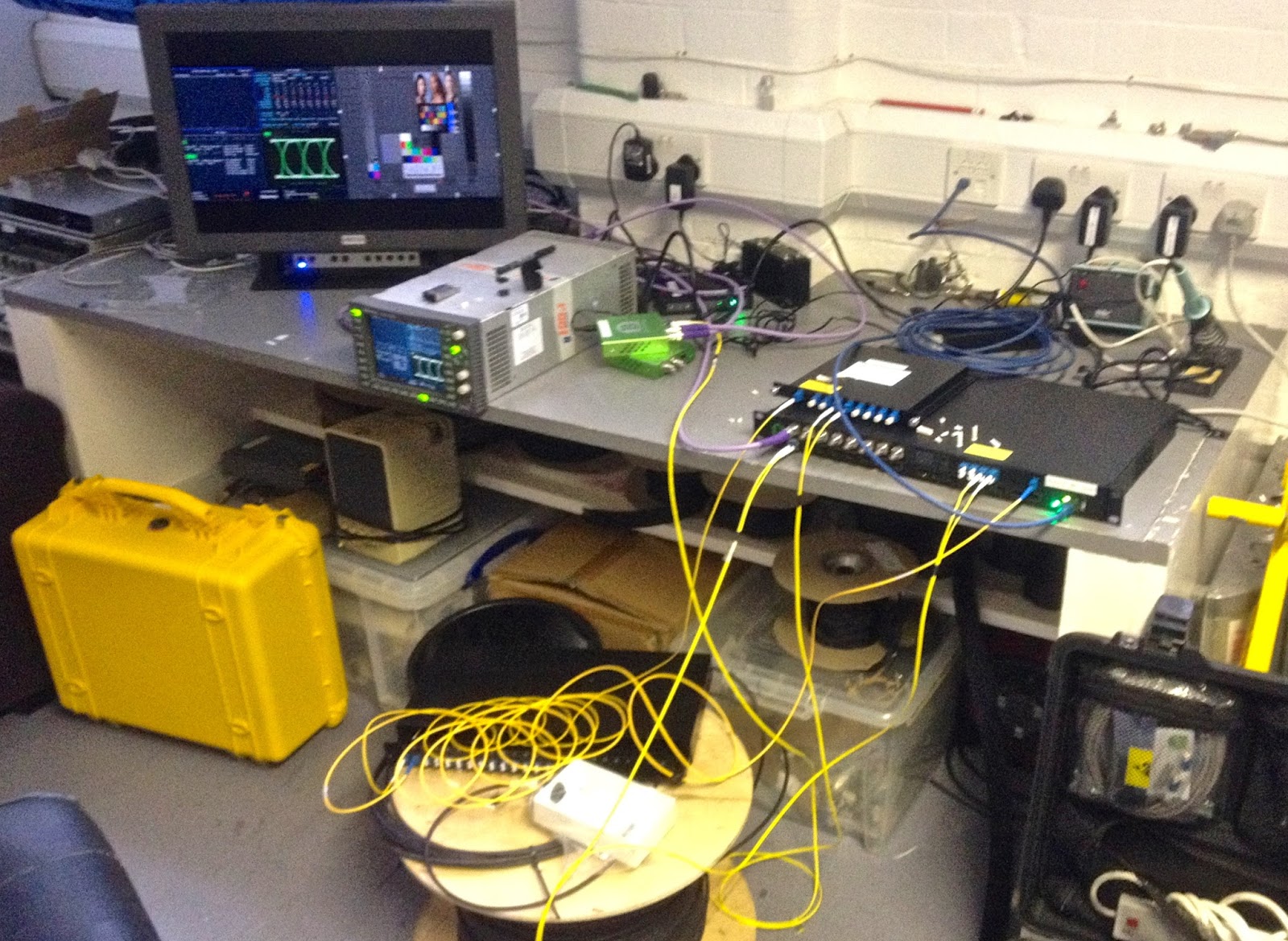

 The Tx and Rx lights on all SFP ports are not data lights, rather they are clock lights and as such only light when you're dealing with synchronous broadcast signals - HD/SDi, MADI, AES etc.
  The CWDM multiplexer/de-multiplexer (they are exactly the same unit!) works both ways and if you have signals going bi-directionally on a fibre each port is an input or an output; that takes a bit of getting your head around!
 In a similar vein the wavelength quoted on SFPs (1350nM in this image) only really applies to the transmitted signal; SFPs are "colourblind" - they don't mind what wavelength they receive. So, once a signal leaves the CDWM de/multiplexer you can take it into any of your SFPs for input to the crosspoint router - again, it's not particularly intuitive as we're used to "tuning" or "demultiplexing" other signals to the frequency they'll be used at.


