Tuesday, March 29, 2011

Video post production a 'dying industry' - yikes!


This is a table nicked from the Wall Street Journal (via my pal Hugh - @hugh_waters on Twitter). On one hand it's very worrying but on the other hand it's what I've suspected.

  1. The equipment required for TV post production is now a £1.5k laptop and not a room that cost a million quid to install (twenty years ago). It's why audio still makes money (you still need an expensive room even thought the equipment is cheap) and why OBs, studios etc will always be profitable.
  2. Post production is largely run by owner-operators; folks who have an emotional attachment to it and will do work at a loss for the love of it and have a far too optimistic view of the future.
I don't know what the answer is - I'm going to try and concentrate on designing/building audio suites, TV studios etc and avoid edit rooms!

Monday, March 21, 2011

Side channel attacks with encrypted data

In cryptography, a side channel attack is any attack based on information gained from the physical implementation of a cryptosystem, rather than brute force or theoretical weaknesses in the algorithms. For example, timing information, power consumption, electromagnetic leaks or even sound can provide an extra source of information which can be exploited to break the system.

Several examples that I think are interesting are;
  • Secure web applications; Bruce Schneier's excellent blog (which is required reading if you have any interest in security/crypto) describes the attack carried out on the IRS's (what they call the Inland Revenue in the US) online tax form site;
    ...it leaks a fairly accurate estimate of your Adjusted Gross Income (AGI). This happens because the exact set of questions you have to answer, and the exact data tables used in tax preparation, will vary based on your AGI. To give one example, there is a particular interaction relating to a possible student loan interest calculation, that only happens if your AGI is between $115,000 and $145,000 -- so that the presence or absence of the distinctively-sized message exchange relating to that calculation tells an eavesdropper whether your AGI is between $115,000 and $145,000. By assembling a set of clues like this, an eavesdropper can get a good fix on your AGI, plus information about your family status, and so on.
  • Compromise of HDCP; The encryption used over HDMI displays is industrial strength and cannot be broken by brute force methods (not in this universe, anyway!) - instead by freezing the memory used by a software BluRay player you can be assured that the volume-key is somewhere in memory. By stepping through 128-bits at a time and having a try at decrypting the first few frames of video (which are very clear when they are decrypted) you quickly find the key for that BluRay or HD-DVD disk.
  • The use of 'cribs' when decrypting Enigma traffic; Bletchley Park had typically less than a day to decrypt most traffic captured from German wireless telegraphy as they changed the rotor-positions in the Enigma machines every twenty-four hours. Apparently the intelligence gained by the French who were experts at recognizing the morse-key style of German operators (and hence were able to track which army group Fritz or Herman worked for) along with a knowledge the ten most profane German swear words and ten most common German girl's names meant they code-breakers had a head-start with seed-words which cut down the key-space to a manageable size that was process-able by 1942 mechanical computers!

Interesting though these examples are, the one that really peaked my fancy this week was the side-channel attach described by the Associated for Computing Machinery on the encryption used in VOIP systems. It turns out that most VOIP systems (Skype included) use variable-bitrate compression ahead of the encryption process (typ. AES at 128-bits). It turns out that by training a Markov Model with the encrypted data (yet knowing what the words spoken were) you can subsequently get around 50% accuracy with data streams from unknown talkers. Given that English has a lot of redundancy you could glean most of what was being said!

Read all about it here.

Thursday, March 17, 2011

Blackmagic, have the courage of your convictions!

I've often bad-mouthed Blackmagic as they often build to price rather than spec. In the past when I've complained about their interpretation of the SDi spec they've always said that so long as they can light-up a monitor they're 'democratizing digital video' or some such(!) Anyhow - Joel showed me that they are now featuring screen-grabs from a Tek rasteriser on their website; they weren't so keen on it five years ago!

Saturday, March 12, 2011

People's expense accounts depend on their unquantifiable skills!

In 1999 the Super Audio CD format was released - higher sampling rate and longer word-length than the venerable 44.1Khz/16-bit Red Book standard that traces it lineage back to the late seventies and the Sony F1 digital audio system.
I've spoken to audio engineers who have made a very good career out of there being a benefit in re-mastering recordings to this newer standard. Their contention is that the difference is "night and day" (please go back and read that post).
Anyway - in 2007 a couple of chaps from the AES did a double-blind test to see if audio professionals could tell the difference - it turns out they can do no better than random. Remember - that was audio engineers, dubbing mixers, and other people who know what to listen for in properly recorded audio. Mix Magazine did a very good write-up under the title of The Emperor's New Sampling Rate!

This all reminded me of a project I was involved in at Oasis TV in the late nineties where we were home-brewing an audio-FX server for the dubbing suites. At the time 9 gigabyte SCSI drives were £1,500 and so compression was implied! None of the dubbing mixers liked this idea and so I made up a CD of various recordings; spot-effects, different music styles, dry vocal recordings and finished mixed programme. The compression we were using was MP2 (so not as good as the now-ubiquitous MP3) at 128, 164, and 192 kBits per sec (as well as uncompressed).
Remember - these were the golden-ears listening on £10k matched amp/speaker combos. It turns out that somewhere between 164 and 192kBits per sec these guys dropped to about 50% accuracy in discerning the compressed audio from the original.
Actually I think it's a bit more complicated than what these two double-blind tests suggest; I store all my music at 192kbit MP3 encoded using LAME 3.9 - for 99% of my music I can't hear the difference. However;
  • On some passages (typ. splash cymbals and some acoustic guitar parts) I am aware of compression artefact's.
  • An old VT editor once told me (around fifteen years ago) that although he liked the look of (the then new) DV format he felt more tired after a day of editing DV footage compared to BetaSP - the differences aren't immediately clear but over time one is better (in some way?) than the other.

I do believe that you can only get to the truth of these things by statistical analysis - I place no faith in audio professionals who expect their view to be taken seriously without the numbers to back it up. Their salaries depend on them being able to 'hear' the differences - if they are there or not.

Friday, March 11, 2011

Stuxnet

I've been following the Stuxnet worm in the technical press and it is fair to say that this is probably the world's first weaponised computer worm. In a very real sense this is cyberwar.
From Bruce Schneier's excellent blog;
Stuxnet was expensive to create. Estimates are that it took 8 to 10 people six months to write. There's also the lab setup--surely any organization that goes to all this trouble would test the thing before releasing it--and the intelligence gathering to know exactly how to target it. Additionally, zero-day exploits are valuable. They're hard to find, and they can only be used once. Whoever wrote Stuxnet was willing to spend a lot of money to ensure that whatever job it was intended to do would be done.

Symantec's report is very thorough but somewhat long!
The best expose on the whole subject is Steve Gibson's podcast on the subject;
http://media.grc.com/sn/sn-291.mp3

Tuesday, March 01, 2011

Tony Drummond-Murray presents...!

This talk will start with the early methods of TV recording using film (Telerecording) and will briefly touch on some of the problems associated with TV cameras of this era. From there it will move on to Videotape recording (VTR), and will be illustrated with a few historical slides showing the early equipment. "VTR" is a vast field in this context, covering Recording, Playback, Editing (physical cutting and electronic splicing), Transverse and Helical scan tape formats, slow-motion and freeze-frame, and so on....

I've known Tony for many years, he is a great guy and a good speaker. We have staff meeting that night so I'll miss this unfortunately.

Thursday, February 24, 2011

Ever need to slow down ethernet?

I've had a few occasions when I've had to force gigabit down to 100BaseT or even 100 down to 10BaseT. My preferred method is to force the NIC down to the appropriate speed but if you aren't using Windows (OS-X, Linux or an embedded device) then a hardware solution is needed.


  • Distance - 100BaseT only goes 100m over cat5e but 10BaseT goes 300m; If you find yourself in that situation then an old 10BaseT hub at the far end does the job.
  • Equipment reports 100BaseT but is only reliable at 10BaseT; my Squeezebox network MP3 player is running a hacked OS and works a lot more reliably at 10BaseT. I achieved this by swapping the green/white and orange cores in the network cable. This degrades the common-mode rejection performance of the cable and means the ethernet switch ramps the circuit down to 10BaseT.
  • Gigabit too fast? Just make off a cable with the blue and brown pairs excluded. Gigabit needs all four pairs and if the switch only sees the Green and Orange pairs it will assume 100BaseT.

Thursday, February 17, 2011

My Presentations at BVE 2011

I've been representin' at the Broadcast Video Expo show in Earls Court. I'll blog about some of the things I've seen at the show later this week but in the meantime here are the slides from my three seminars;

These are all tasters for the training days I run at root6.

Friday, February 04, 2011

Rise times in HD TriSyncs

To my shame I haven't blogged for a month! We are starting to pick up at work with projects on the go and the BVE trade show at Earls Court in just over a week (I'm presenting each day - will post my slides next week).


These are two traces from two separate TriSync generators - The blue trace represents a correct waveform and as every superhero will realise you're looking at the line timing pulse. Here is the diagram from rec-709 (the spec for HD video);


It clearly shows that rise time is to be equal between the start, middle and end of the line-sync pulse. The rep from the manufacturer of the green pulse insisted that his waveform was a lot sharper - but given the ringing on it I think they just aren't filtering it properly to comply with the rise time spec - seen here (again from rec-709) as being 4 clock cycles +/- 1.5


Thanks to an unnamed ex-colleague(!) for engaging me in this conversation! The link in the title is to the summary document PDF of rec-709.

Tuesday, January 04, 2011

Hopes for 2011

  1. Teradici PCoIP starts working with Snow Leopard - Apple broke USB HIDs in 10.6 and so standard USB cards (which the Teradici HBA looks like to the OS) are not recognised (as they were in Leopard and are in XP, Win7 & any Linux).
  2. Someone launches a USB DVB-T2 adaptor - seriously, I want to upgrade my PVR to FreeviewHD!
  3. The industry starts to pick up; at some point effort for the BBC move to Salford and the Olympics have to trickle down to London-based SIs
  4. The Dolby PRM-4020 monitor starts to ship in the UK - see here.
  5. UK broadcasters start to take HD seriously before getting all excited about 3D
  6. UK broadcasters start to treat SD channels with some technical quality before getting too excited about HD!
  7. 3D in the cinema dies on the vine - the number of folks choosing to pay for it when they have a choice dropped off consistently throughout 2010 and so presumably at some point it will become economically nonviable.
  8. The root6 tech podcast eventually takes off (watch this space!).

Monday, December 20, 2010

Monitoring in 5.1


Nice article that Colin Birch (@InformedSauce on Twitter) mentioned this morning - I PDF'ed it as the online reader that Broadcast Engineering World use is clumsy. Click the link in the title of this entry.

Wednesday, December 15, 2010

Rio / Sonic Blue / Dell Digital audio receiver


I picked up these on eBay for a fiver a go! They are tiny little Linux boxes that stream audio from a nominated PC on your network. The original Rio/Dell software is very 2002 and although adequate offers no integration with iTunes or Windows Media Player. When you power the box it shouts out a BootP request (that's an old protocol I haven't had to deal with since Phillips/Thompson routers of the mid-90s!) and that starts the download process of a tarball that has the Linux kernel to run the box. Once that's loaded it grabs an IP address via DHCP (from the same client software that serviced the BootP request - I guess not many people had home-routers when this was a product!) and you can then stream your MP3s to it. It has a nice display, IR remote and the audio output quality is good.
However, since it's demise it's become a target for home-brewers and hackers and there is a new kernel that makes it look like a Squeeze Player - the standard that Logitech have used for all of their home entertainment products. This makes it quite an interesting gadget as a network music/streamed radio player and it didn't take me very long to get it working with my Windows 7 media center. Using Logitech's server mean it integrates brilliantly with iTunes and you get access to all the BBC's iPlayer and streamed radio.


Once you've got Squeezebox running you can use it to stream to WinAmp, your iPhone or even another instance of iTunes (rather perversely!).

So, here are the bits you need;
Rio's v. 1.04beta which was the last release. It's the only one that works with Windows 7 and it doesn't have all the instabilities previous releases had with 10 vs 100BaseT ethernet (this was the early noughties after all!).
SlimRIO is the tar-ball with the new kernel to make the box behave like a Logitech Squeeze player.
Squeezebox is the server that makes it all work nicely.
Finally you'll probably need a copy of the LAME encoder so that the server can transcode AAC, RealMedia etc into MP3 streams for live radio - lame.exe - it needs to go in;
\Program Files\Squeezebox\server\bin

Thursday, November 25, 2010

Video and high-speed networks - article in Broadcast Engineering Magazine


What an up-market magazine Broadcast Engineering is! Well, when they publish my stuff.
You can snag a PDF of the print version from my DropBox; BroadcastEngineering_Article_Nov2010.pdf

Thursday, November 18, 2010

You know you're getting old when.....

OB Trucks you built are knocking about on the 2nd hand market!


They've also used the photos I took back in 2001! The same thing happened when I took a load of pictures of the same truck being lifted in to Fame Academy in 2002. Loads of people used these images and I never got as much as a thank you.

Wednesday, November 10, 2010

High Dynamic Range video

We all know about high dynamic range (HDR) imagery due, in part, to the examples you can find on Flickr. This image I nicked from Wikipedia shows how three bracketed shots are combined into a composite image where you have all the details in both the blacks and whites that couldn't be captured in a single image.


So how could you achieve this with moving images? Have an ultra high frame rate camera where you can capture three frames sequentially with a rotating set of ND filters? Maybe, but the focus and effect are somewhat spoiled by rapid moving parts of the image. The guys at Soviet Montage have a system where they use a beam-splitter to feed the same image into two 5D Mk2s (one of which has 24dBs of attenuation - that's four stops for non-video people!).

HDR Video Demonstration Using Two Canon 5D mark II's from Soviet Montage on Vimeo.

I think it looks very engaging. Kind of like a moving old-master. For my money this is much more engaging than 3D on TV with none of the problems that 3D at home have.

Thursday, October 28, 2010

Most memorable gigs I've ever been to

  • Level 42, Birmingham Dome, 1983
  • Bruce Springsteen and the E-Street Band, Wembley Stadium June 1985
  • Billy Bragg, Wolverhampton Civic Hall, May 1986
  • Eden Burning, Brixton Academy, August 1994
  • Kevin Prosch, The Forum, April 1996
  • The Vigilantes of Love, The Borderline, June 1999
  • Counting Crows, Wembley Arena, September 2003
  • Julie Lee, The Borderline, August 2005
  • All Star United, The Half Moon, Putney, November 2007
  • Martin Joseph, Union Chapel, September 2008

Wednesday, October 13, 2010

Babbage's Analytical Engine

In December 1837, the British mathematician Charles Babbage published a paper describing a mechanical computer that is now known as the Analytical Engine. Anyone intimate with the details of electronic computers will instantly recognize the components of Babbage's machine. Although Babbage was designing with brass and iron, his Engine has a central processing unit (which he called the mill) and a large amount of expandable memory (which he called the store). The operation of the Engine is controlled by program stored on punched cards, and punched cards can also be used to input data.
John Graham Cummings is trying to get together the money and team necessary to actually build an Analytical Engine - aside from it being the coolest Steam Punk project ever it will give a real insight into how computation is independent of physical arrangements (we won't always be running our computers on silicon) AND it is possible for someone to be literally a century ahead of the curve. Remember - this machine was Turing-complete and so can be considered in the same category as modern computers.
As an aside the Science Museum made a Difference Engine in the early nineties using only materials and techniques that would have been available to Babbage and it worked well. The difference engine is not a Turing-machine, it was used to automate the production of printed log tables but is equally as impressive.
If you want to hear John talking about the project then he is on this week's TwiT and is jolly interesting.

Monday, October 11, 2010

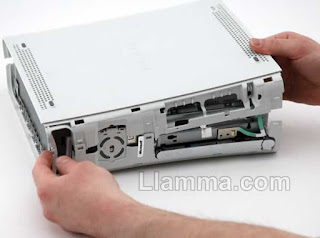
Replacing the DVD drive in an XBox360

Microsoft realised after the original XBox that folks would find ways around the games' DRM and so in the case of the 360 they make it as hard as possible to use anything other than the stock optical drive that came with the machine. Every motherboard and DVD drive pair each have half of an AES key pair and so if you install another drive it'll play video DVDs but not games. They hoped this would stop people sticking in non-stock drives that could (for example) read home-burned disks. However, the hacking scene around XBox is extensive and so in pretty short-order there were hacker tools to read the drive's key and then flash it into a replacement drive.
Microsoft got wise to this pretty quickly and the summer 2008 update to XBox requires not only the key halves to work together but the drive ID strings to match. So - if you had a machine with an Hitachi drive and replaced it with a BenQ drive (for example), even if you extracted the key from the Hitachi and re-flashed the BenQ the XBox's OS would now query the drive ID and stop it working if that came back wrong.
Hackers are clever people and since v4.5 of Firmware Toolbox it's been possible to include the old drive's ID in the firmware for the new drive. This is what they refer to as 'spoofing'. It turns out that the drive ID is just that - a string that has no bearing on the drive's operation. So - your BenQ drive can now report it's an Hitachi 79 with this key and the XBox is happy.
Well, it's spy vs spy and the rumor is that the next update to XBox will include routines to test the ballistics and responses of the DVD drive to ensure it's the model it claims it is...!

So - if you have an XBox with a DVD drive that is on the way out (and it's almost always the laser) then you have three options which may/may not work;
  1. Open the machine, remove the DVD drive, open it and clean the lens with some IPA or some such. Seems to work for lots of people.
  2. Buy an identical model DVD drive on eBay (there are plenty of all four kinds for sale sub £20 from broken machines or around £30 for brand new ones). Then swap the controller cards between the drives. This means you have the old electronics but new mechanics/optics.
  3. Extract your old drive and using the right tools read-out the key and drive IDs, save them and then write them into a replacement drive (which can be another brand and model). This is potentially the most risky as anyone who has flashed firmware into any device will tell you. Browsing the forums reveals many folks complaining about having bricked their newly acquired drives. Also - if the XBox detects what you've done you'll be kicked off XBox-Live (both your machine and your account).
Anyway, if you're any kind of engineer and have any experience opening up equipment the first two are trivial. If you choose the third way (Mr Blair!) then it's worth giving some guidelines.
Whichever way you proceed you'll need to open the thing up and it's mostly held together with fragile plastic clips, and so here is the best tear-down instructions I have found.
Also remember - the XBox DVD drives have a standard SATA connector but a proprietary power connector. For all these tests I left the drive in the XBox (which powered the drive) and I used a long SATA cable to go to the eSATA port on the back of the PC. Now then - the XBox has a class-two (double-insulated) design and so the internal metalwork is floating at some undefined DC voltage. I suggest an earthing lead from the XBox's internal chassis to the PC's metalwork.

Extracting that precious key from the broken DVD drive
  1. Connect the "Original/Broken DVD drive" to your PC via SATA or USB-SATA adaptor.
  2. Place the DVD drive into MODE B with SLAX - SLAX is a live Linux CD that allows you to issue SATA commands directly. A good tutorial is here
  3. Please Note: Once you have the drive in MODE B you will notice it will take 3 presses on the eject button to close the drive.
  4. With the Original/Broken drive now in MODE B restart your PC and make sure that the new drive has been identified by Windows. Once the new hardware has been found and installed it will be shown in the my computer/explorer area on your PC as a additional DVD drive.
  5. Insert a DVD Movie or an XBOX 360 game into the "Original/Broken DVD drive". Even if the laser is nearly dead it may read a DVD movie just fine so try it.
  6. Open Firmware Toolbox (at least v. 4.5.1.6) and choose 'Tools -> Direct Drive Dump (GDR ONLY)
  7. On the next screen choose 'RAW DUMP' and save the file as "original.bin". If you have problems with 'RAW DUMP' try 'CLASSIC DUMP', eg. c:/xbox360/hitachi0047/606HG324277-may2006/original.bin
  8. Make sure you can identify the backup firmware in future by placing it in a directory that matches the serial number which is located on the sticker of the DVD drive. This will make it much easier to identify in the future.
Replacement Xbox 360 DVD Drive
  1. Connect the replacement DVD drive to your PC via SATA connection.
  2. Place the DVD drive into MODE B with SLAX
  3. Please Note: Once you have the drive in MODE B you will notice it will take 3 presses on the eject button to close the drive.
  4. With the replacement drive now in MODE B restart your PC and make sure that the new drive has been identified by Windows. Once the new hardware has been found and installed it will be shown in the my computer/explorer area on your PC as a additional DVD drive.
  5. Insert a DVD Movie or an XBOX 360 game into the Replacement DVD drive.
  6. Open Firmware Toolbox and choose 'Tools -> Direct Drive Dump (GDR ONLY)
  7. On the next screen choose 'RAW DUMP' and save the file as "original.bin". If you have problems with 'RAW DUMP' try 'CLASSIC DUMP'. eg. c:/xbox360/hitachi0046/606HG324240-may2006/original.bin
  8. Make sure you can identify the backup firmware in future by placing it in a directory that matches the serial number which is located on the sticker of the DVD drive. This will make it much easier to identify in the future.
  9. When the firmware is backed up it will ask you if you want to open it. Choose"yes". Now select "Tools->Spoof Firmware" from the Firmware Toolbox 4.5 menus.
  10. Choose the version that you would like the fw to report back as. Leave all other options as they are.
  11. Please note: - Spoofing a drive as itself has the effect of UNSPOOFING it
  12. Now Click "APPLY SPOOF"
  13. Choose "Tools->Smart Hack Patcher", a window warning will appear, choose OK.
  14. Choose the output file name, I suggest calling it "final.bin" and save it at the same location as the original. The ruleset option should be automatically selected for you so leave it alone. eg. c:/xbox360/hitachi0046/606HG324240-may2006/final.bin
  15. Push the "Generate File" button, if everything goes fine the file will be generated almost instantly
  16. Once the file has been generated it will ask you if you want to open it. Choose "Yes". The Main Window will show the generated file (final.bin). You will notice that the spoofed information is shown in bold.
Original/Broken Firmware Key
  1. Open the old original/broken DVD drive firmware which you backed up in step 1. Choose the Browse for file button "..." to load the original/broken DVD firmware.
  2. With the old broken DVD firmware now loaded you will notice the "Key Information @" area in the center of the 360 Firmware Toolbox application.
  3. Highlight the entire key and copy it by right clicking your mouse and selecting copy or press Ctrl + C so you can paste it into our new replacement drive.
  4. Open the replacement DVD drive firmware named "final.bin" which you created in step 2. Choose the Browse for file button "..." to load the firmware.
  5. Paste the Key into the "Key Information
  6. Click on "Replace Key" and it will update the firmware with the new key you have just pasted.
Check Firmware Differences

Before flashing the drive I suggest re-opening the old firmware from step 1. Then open the final.bin firmware you just created in step 3 and make sure keys and other information match just to be safe. If you're happy that your keys etc match then move onto flashing the drive.
  1. Choose "Tools->Direct Drive Flash->Differential Flash Patch". Make sure the DVD drive you want to flash is selected
  2. Click the "Read Drive and Detect Differences" button, after a few seconds the sectors list below the button should be populated.
  3. It will now ask you if you would like to keep the keys from the drive.. Choose 'No'.
  4. Click the "Start Flashing" button and choose the flash mode.. I suggest using the 0047 flasher for 47 drives etc etc..
  5. After a few seconds the flashing is complete.
Replace the DVD drive into the XBox and test - you don't need to re-build the case and re-attach the hard drive.


Resources;
SLAX Linux live CD
Firmware Toolbox

Thursday, October 07, 2010

The end of universal benefits?

I watched Mr Cameron's speech yesterday with some interest. I had thought for a while that child benefit for all was strange (although Sarah and I have come to depend on it over the last few years) and I'm surprised higher rate tax payers have received it for as long as they have. They should have avoided the debacle over the aggregated salary issue, but there you go.
Anyway - it got me wondering about other universal benefits which could (presumably) be cut for those folks who make too much (or contribute to the system too much?!);
  • Healthcare - why should people who make enough to pay 40% of it back into the system expect to receive free hospital treatment?
  • Education - This is an area where a gradual erosion of support for teachers and head-teacher's rights to run their schools they way they want to has caused a defacto segregation. Those who can afford it and value education end up paying for it. Presumably by means-testing state-provided education you could free up loads of money.
All of this breaks the fundamental aspect of the welfare state that says we're all in this together - you contribute as you can and you're provided for as you have a need. For this reason the government shouldn't be looking for ways to take low-earning workers out of the tax system. The danger of building a welfare state where some provide (and are still told they need to 'shoulder their part of the cuts') and some take is that eventually the providers wind up voting for government that stops spending their taxes on things that don't benefit them - as in the US.
It may not be the case that cutting one universal benefit will lead to the others becoming means tested but the UK may have crossed the Rubicon.