Best thing I've heard so far this year - full band/studio album from the most talented song-writer still working in the USA.
"...noisy, jangle-y, lush, passionate, Rickenbakers, hooks, '60's, '70's...cobalt blue skies;"
all songs by Bill Mallonee
released 02 October 2011
Bill Mallonee: vocals, guitars (electric, acoustic, hi-string) harmonicas
Muriah Rose: vocals, piano, organ, mellotron
Bert Shoaff: bass
Kevin Heuer: drums, percussion
Friday, October 21, 2011

Wednesday, October 19, 2011
Save us from Media Studies students!
I was on the train on the way up to Manchester this morning - on the next table along were four undergraduates on the way to the BBC for a recruitment day out and clearly part of their day was to propose potential new programme formats. Well - they spoke very loudly and earnestly about their ideas for radical new television shows and all made notes in their moleskin notebooks. Their ideas were so derivative and tired it made me chuck and I made a note of some of them;
- "Darts players - wives & girlfriends" - a reality show investigating the love lives of darts players. @bendavison tells me it's been done already, sigh.
- A series of documentaries that challenge racism by featuring the apparently growing Bollywood porn industry...!
- "Strictly come prancing"- reality show for jockeys.
- "Blaggers with attitude"; documentary series following people around the festivals who manage to score free stuff; t-shirts etc.
- "Bankrupt celeb finance boot-camp"; broke Z-listers learning how to manage the money they get from Heat Magazine.
- "Boyle Baron" - singer Susan Boyle learns the ins and outs of the oil industry.
- "The Grapes of Hoff"- David Hasselhoff becomes a vintner.
- "Frankie goes to Bollywood" - ex. members of the 80s band learn Indian dance moves; they also discussed if it should be for Comic Relief(!)
- "The Yids are alright" - Pete Townsend explores Jewish culture.
- "Train of thought"- a gameshow set on the West Coast Mainline. Different stations would signal different rounds. Would suit Alan Titchmarsh?
So - BBC, stop employing media-studies graduates and instead give English/History/Classics students a shot at making some original TV.
If you see any of these formats on BBC3 in eighteen months time you read it here first!
Friday, September 30, 2011
The Monty Hall problem
This is a scenario made popular by the American game-show "Let's make a deal"; The host, the eponymous Monty shows the contestant three doors and tells them there is a car behind one of the doors and booby prizes (typically goats) behind the other two. The contestant gets to choose a door and then Monty opens one of the doors they didn't choose showing them a goat. He then offers them the chance to change their mind. Initially most people say something like "..it's fifty-fifty, so no, I won't change" - but it's not 50/50, changing your mind at this point doubles your chance of getting the car.
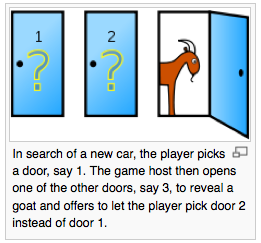
Possibly because I did a year of Game Theory on my degree the first thought I had when I initially heard this problem was "where are the odds invested?". When you pick your first door your odds are a third. However - two-thirds odds are invested behind the other two doors and when Monty shows you which of those doors has a goat you know that none of the odds are now behind the door he just showed you; the car can't be behind that door (Monty showed you the goat). Your original door still has a third of the odds and so now the final door MUST carry the two-thirds odds that you didn't choose initially. Changing your mind now doubles your odds.
It's not a straight fifty-fifty because Monty introduced some new information half-way through the game. He showed you which of the two-thirds doors don't have the car.
The Wikipedia article is very good - I nicked the picture from there.
The problem is interesting because it shows how little innate understanding of game theory (and statistics, and probability) most people have. You gotta trust the maths, not your instincts.
Thursday, September 29, 2011
Recovering corrupt flash memory cards
The good thing about paid-for photo-recovery software is that they have an easy trial-model; they show you the images and videos they can recover and you stump-up your $50 to register the software and get at your pictures. I've had varying success with a coule of paid-for apps but I came across PhotoRec yesterday (it's part of a larger suite of tools).
Now, granted, the pay apps have nice GUIs while PhotoRec runs in the UNIX shell in a text-based interface, but it requires little interaction and gets the job done. It also runs on just about any common OS platform from Mac OS X to Windows to Linux to Solaris, etc. Link in the title.
Now, granted, the pay apps have nice GUIs while PhotoRec runs in the UNIX shell in a text-based interface, but it requires little interaction and gets the job done. It also runs on just about any common OS platform from Mac OS X to Windows to Linux to Solaris, etc. Link in the title.

Friday, September 16, 2011


Wednesday, September 14, 2011
Things that peaked my interest at IBC
I spent just a couple of days over at the RAI in Amsterdam. It was splendid to catch up with some old pals and Bryant Broadcast do an excellent night out. My main observation is that 3D/stereoscopic was no where near as prominent as it was last year and as the number of network delivery solutions increases the number of 'proper' transmitter companies seems to drop.
Newtek - updates to TriCaster, new model & control panel. The new 450 is very similar to the 850 but has only four HD inputs (against eight). The other things that I think are significant;
Newtek - updates to TriCaster, new model & control panel. The new 450 is very similar to the 850 but has only four HD inputs (against eight). The other things that I think are significant;
- 3Play - their "poor man's EVS" has been improved. Running on what looks like a Tricaster 850 chassis it now has eight inputs and can run two outputs simultaneously. For sports slow-mo it is an excellent quick turn-around solution at the fraction of the cost of EVS.
- VTR-style control for the DDRs in Tricaster; might suite some people.
- Tricaster Extreme upgrade - allows for eight ISO records (can be either cameras or other internal/external sources, at different rasters and codecs than the main record).
- They fixed the AUX audio in embedded HD-SDi I'd been moaning about!
- The network sources (iVGA feeds) can now carry audio as well.
VidCheck - file-based QC is getting good! In fact this one looks like it needs serious consideration! I have a demo license on the way and will report back. Along with being able to test all the usual codecs etc it does full ITU.1770 audio loudness AND has numerous correction facilities; Tektronix AND Eyeheight, you might say.
- Containers: MPEG-2 TS, MPEG-2 PS, MXF, MP4, MOV, ASF, AVI, LXF, GXF, FLV, F4V
- Formats: Web, SD, HD, D-Cinema and many custom formats
- Video: MPEG-2, IMX, XDCAM, D10, HDV, DV25, DVCPro50, DVCPro100/HD, AVC/H.264, VC-1, ProRes, DNxHD/VC-3, MJPEG
- Audio: MPEG, PCM, WAV, AAC, stereo, 5.1 / 7.1 Dolby, multiple different language tracks
The really significant thing is the price €5k with paid options (DolbyE, ProRes etc) in the hundreds rather than thousands of pound. It also seems to handle multi-core computers much better, a single instance scaling to 28 cores.
AutoQue - they make broadcast monitors, who would have thunk it? They seem to be pitching them very much against the JVC DT-V24 series at the bottom end (a grand cheaper) and the VuTrix at the edit suite/grade-1 end (again, a lot cheaper). I have demo stock coming so I will write a bit more when I've seen them.
Other things worthy of note - Tek now have all their 3D analysis tools in the WVR/WFM-8000 series 'scopes. I had a very informative half-hour with Lee Ballinger from Tektronix going over them.
Other things worthy of note - Tek now have all their 3D analysis tools in the WVR/WFM-8000 series 'scopes. I had a very informative half-hour with Lee Ballinger from Tektronix going over them.
Friday, September 09, 2011
Security and the Diginotar debacle

You might have been following the trouble that the Dutch SSL-certificate issuing firm Diginotar have been suffering recently. It transpires that Iranian hackers have got into their system and have spent several months issuing themselves wildcard certs for well known domains, most notably *.google.com - it essentially means these ne'er-do-wells can sign certificates that look like they have come from Google and your browser would be none the wiser. In fact it's not that severe unless you've been the victim of another attack;
- Man-in-the-middle attack - you might be in a coffee shop where someone has managed to poison the ARP-table in the router and inserted themselves into your wireless comms. If they served up the fraudulent cert they could make any domain (especially there own server) look like you were securely connected to.
- DNS-poisoning attack - as highlighted by Dan Kaminsky a couple of years ago it is possible to for elderly versions of BIND and more contemporary versions of IIS to incorrectly serve up DNS look-ups. Once this is in place the fraudulent cert on the same server would have you believing you had a secure connection.
- Corporate decrypting proxies; many corporations install their own certificate on all client machines and essentially do a man-in-the-middle SSL intercept. Your traffic to Amazon.com is encrypted, but it goes via the proxy where it is momentarily decrypted for your boss to look at! If a corporate proxy was compromised dodgy SSL certificates could have you believing you had an encrypted connection to Amazon.
All of this raises issues with SSL - when I first started using an SSL browser (Netscape Navigator v.2 IIRC in '95!) there were around seven or eight trusted issuing CAs. Now there are hundreds (including the Hong Kong Post Office!) and it comes as no surprise that some of them get compromised sometimes. What I don't understand is why browsers don't keep a record of the CA associated with domains and when they see a change (particularly if a cert had time to run) inform the user? There is a plugin I use for Firefox called "Certificate Patrol" that does just that and it's easy to use and unobtrusive.
Now then - the whole Diginotar story started three months ago and they didn't spill the beans until last week; security is never served by secrecy. Also - it took Apple far to long to patch Safari. I think if you're concerned about network security then avoid Safari on OS-X.
Now then - the whole Diginotar story started three months ago and they didn't spill the beans until last week; security is never served by secrecy. Also - it took Apple far to long to patch Safari. I think if you're concerned about network security then avoid Safari on OS-X.
Saturday, August 27, 2011
Sony BVM-E250 OLED broadcast monitor
 I had an hour or so to set up a new Sony OLED grade-1 next to a Vutrix HD Pro-24 (their grade-1 LCD display which I like) - the Sony is twice as expensive as the Vutrix (£20k vs £10k). OLED as a technology is supposed to have a number of advantages over thin film transistor (TFT - the important bit of an LCD display. A few are;
- In a TFT layer the polarisation of light is twisted through 90 degrees to allow the pixel to be illuminated by the virtue of the fact that the front filter is 90 degrees offset from the rear. In effect the transistor stops the light from the fluorescent (or nowadays LED) source. Since the light source is a few millimeters behind the pixel there are chromatic distortions inherent and since thin-film transistors don't shut-off all the light when turned off there are black-level issues. These are the two best known problems with LCD monitors in film & TV grading.
- Thin-film transistors have a limit to how quickly they can be cycled - typ. 16ms at best (I know some manufacturers claim faster but it's smoke & mirrors). OLEDs can be cycled a lot quicker for better response.
- In a TFT display the place where the colour is made (the three sub-pixel RGB transistors) is physically separate from the light source - not so with OLEDs where the illuminating LED is also the colour-maker.
So - with deeper blacks and fewer chromatic problems you'd think OLEDs were the way forward. The only thing to consider is the life-span. The blue OLED elements have an estimated life of 10k hours (around a third of the backlight of an LCD). Also - the metameristic character of OLEDs is different and so colour-management tools will need to be upgraded (I just spent £7k on a new LCD photometer!).
I thought out of the box the pictures on the BVM were very good - close to the VuTrix I'd just calibrated to illuminant-D (6504K at 80Cd/m2 for peak white). Response seemed as good with much better blacks, particularly from different angles. The monitor's de-interlacer didn't seem as good as I'd have expected for video-shot material but camera pans etc looked better than the VuTrix.
Overall I was impressed, but not an extra £10k impressed!
I thought out of the box the pictures on the BVM were very good - close to the VuTrix I'd just calibrated to illuminant-D (6504K at 80Cd/m2 for peak white). Response seemed as good with much better blacks, particularly from different angles. The monitor's de-interlacer didn't seem as good as I'd have expected for video-shot material but camera pans etc looked better than the VuTrix.
Overall I was impressed, but not an extra £10k impressed!
Friday, August 26, 2011
UPNP has always been a bad idea!
UPNP is a protocol that allows an application to open up ports on a router so that incoming packets from the Internet get to the correct IP address on the LAN. It's typically used to allow the XBox360 to set up open ports through your router to allow multi-player gaming. If both XBoxes are behind NAT routers there is no way that unsolicited traffic from one can make it to the other (hey, I never wanted your bullets to hit me!). Skype suffers thus if both callers are behind NAT routers (i.e. in most cases; who has an internet-facing IP address on their machine nowadays?) - details here). More recent versions of Skype will make use of UPNP if it's on the router.
You won't be surprised to learn that it's a Microsoft technology and I've always encouraged people to disable it on their routers. Any piece of malware inside your network can open ports and invite any other nasties in. In the case of XBox there are about four ports you need to open up for the Live! service to work. Anyhow - it turns out that Linksys routers have a bug that allows UPNP activation on the WAN side - that's right, with the correctly formatted packets you can open ports through a Linksys router from the Internet. Using something like UPNP Port Mapper will allow you to scan Internet IP addresses and open ports on those routers.
The title link is to the article on The H.
You won't be surprised to learn that it's a Microsoft technology and I've always encouraged people to disable it on their routers. Any piece of malware inside your network can open ports and invite any other nasties in. In the case of XBox there are about four ports you need to open up for the Live! service to work. Anyhow - it turns out that Linksys routers have a bug that allows UPNP activation on the WAN side - that's right, with the correctly formatted packets you can open ports through a Linksys router from the Internet. Using something like UPNP Port Mapper will allow you to scan Internet IP addresses and open ports on those routers.
The title link is to the article on The H.
Thursday, August 25, 2011
Flame ain't all that
 The facility that I'm building at the moment has a couple of Flame Premium suites - the very best version of Autodesk's TV and film compositing and finishing tool. Now I know very little about Autodesk products - I've never really worked in facilities where they were used. Flame, Smoke and the rest of them have been around for nearly twenty years and so you'd think they are what software people would describe as "mature products".
Anyway - a currently model Flame runs on an HP Z800 workstation with a Kona K3 card for video i/o (more about that in a minute!), an nVidia 4500 for desktop and their own proprietary fibre attached storage called "stone". They can typically handle two streams of 2k in realtime.
All very good, but everything is specified in a system - even down to the Eizo monitor you can use for the desktop display. This is because the SDi output for preview (which is not the output of the K3) is made by looping the 2nd DVI output of the graphics card into a daughter card that converts it to SDi. Consequentially you often see bits of the GUI on the HD video monitor. Now the reason for them specifying a certain model of GUI monitor becomes evident - they have to run the output at a rate near video for the DVI output to be convertible! This gets even more silly when you find out you have to use their own provided long DisplayPort cable to run it. We'd run in LC loose-tube fibre with DVI extenders which initially only worked whilst Linux was booting in text mode (i.e. before the X11 display subsystem could run). I had to throw in a Lindy EDID manager to fool Linux into thinking it really had the Eizo directly connected before we could run the desktop (and hence the Flame application).
This, along with a ton of little bits that the kit ships with; an 8-port ethernet hub, Lucid AES->analogue converters etc gives the impression they expect you to install the system on your dining room table rather than in a pro video facility. It really has the feel of a v.7 Avid from 1996! Cobbled together from third-party bits and only just running (everything on the hairy edge).
It reminds me of the Abekas DVEous (again, 1996) - one of the design engineers confided in me that if every bit of silicon on the video-processing board only performed to published spec then the system couldn't work. They relied on everything outperforming itself.
Thursday, August 18, 2011
Mute the TV automatically!
I've been a fan of ComSkip (a PVR plugin that automatically detects/removes TV adverts from recorded MPEG2 transport streams) and I firmly believe that technology will allow us to 'tame' various media sources - advert blocking in Firefox makes the web a nicer place, for example. Anyway - this is great, what a project;
Wednesday, August 17, 2011
iPhone 4 battery fault? NO!
 Yesterday my iPhone 4 starting showing all the signs of a failed battery - the back of the 'phone was hot and it could hold a charge for around three hours. Darn - replacement handset with all the attendant messing around (although it a lot easier than it ever was on Windows Mobile!).
Anyhow - Googling around brought up a few sites with folks suggesting the mail daemon can get stuck trying to synchronise with Exchange and merely turning off push and letting the 'phone entirely discharge (or doing the hard-reset method of holding down the home and power buttons until the 'phone has powered off and restarted) and then re-enabling push sorts it.
settings>mail,contacts,calendar>fetch new data>advanced
By jove - it did the job. I can only assume the handset burns through the battery by keeping a data connection open continually.
I haven't blogged much recently because I've been on holiday. Pics here
I haven't blogged much recently because I've been on holiday. Pics here
Tuesday, July 19, 2011
Making iPhone ringtones from MP3s
1. Start iTunes and find the song you want to convert. (It must be an MP3.)
2. Right-click the song and choose Get Info.
3. Click the Options tab.
4. Check the Start Time and Stop Time boxes, then enter times for each (no more than 30 seconds apart, the maximum length for a ringtone). I used 0:00 and 0:30, respectively, as "Spit It Out" has a perfect ascending lead-in.
5. Click OK, then right-click the song again and choose Create AAC Version. You should immediately see a new 30-second version of the song. You need to make your import settings are set for AAC (I normally leave them as MP3).
6. Drag that version out of iTunes and into the folder of your choice.
7. Delete the 30-second version from iTunes and undo the Start Time/Stop Time changes to the original.
8. Open the folder containing the 30-second AAC file you dragged out of iTunes, then change the file extension from .m4a to .m4r. Double-click it and it immediately gets added to iTunes' ringtone library.
9. Finally, sync your iPhone. When it's done, you can head into the settings and select your new ringtone.
Couple of gems; Spanish Flea and Hawaii 5-0
2. Right-click the song and choose Get Info.
3. Click the Options tab.
4. Check the Start Time and Stop Time boxes, then enter times for each (no more than 30 seconds apart, the maximum length for a ringtone). I used 0:00 and 0:30, respectively, as "Spit It Out" has a perfect ascending lead-in.
5. Click OK, then right-click the song again and choose Create AAC Version. You should immediately see a new 30-second version of the song. You need to make your import settings are set for AAC (I normally leave them as MP3).
6. Drag that version out of iTunes and into the folder of your choice.
7. Delete the 30-second version from iTunes and undo the Start Time/Stop Time changes to the original.
8. Open the folder containing the 30-second AAC file you dragged out of iTunes, then change the file extension from .m4a to .m4r. Double-click it and it immediately gets added to iTunes' ringtone library.
9. Finally, sync your iPhone. When it's done, you can head into the settings and select your new ringtone.
Couple of gems; Spanish Flea and Hawaii 5-0
Thursday, June 23, 2011
Two location-based things I'd like from my smartphone
- Location aware mute; I'd love to have a silent setting that unset itself when you moved more that (say) 50m from your current location. I have often put my iPhone into silent mode for a meeting and then noticed later in the day that I've missed several call because I forgot to take it out of that mode. Also - time-based silent-mode. I'd like my 'phone to auto-silence every Sunday 10:30 - 12:30 'cause I'm in church (for example).
- Location aware alarm; I've often missed a train stop because I've fallen asleep listening to a podcast or music. Why can't I set an alarm that rings in my earbuds when I get within five miles (say) of a location? Also - the ability to announce the time every ten minutes in the earbuds would be great.
Thursday, June 16, 2011
Bitcoin
 Unlike other digital currencies, Bitcoin avoids central authorities and issuers. Bitcoin uses a distributed database spread across nodes of a peer-to-peer network to journal transactions, and uses digital signatures and proof-of-work to provide basic security functions, such as ensuring that bitcoins can be spent only once per owner and only by the person who owns them.
My introduction to Bitcoin was via Steve Gibson's "Security Now" podcast; (check out episode 287 here). Along with the Wikipedia article my interest was peaked. Bitcoin seems to be a real, credible digital currency that is cryptographically secure. However - a currency needs to appeal to more than engineers and the economists are up in arms about it - read the very entertaining exchange here.
Sunday, June 12, 2011
Estimating the time a job takes
For the last eight years I have spent a lot of my time quoting for broadcast installation builds. From small single edit suites to £1.5m broadcast editing centers I think I have a good feel for how long most jobs take. I recently did a search of my arrogated purchase orders folder and discovered I've bought more than 500 equipment cabinets, nearly 1000 video jackfields, and just over 100 kilometers of bulk fibre optic cable - all in the last eight years!
Anyhow - I often get quotes thrown back at me by chief engineers who assume I'm trying to fiddle them and they will typically say;
Anyhow - I often get quotes thrown back at me by chief engineers who assume I'm trying to fiddle them and they will typically say;
You've quoted ten days for a wiremen to wire those audio patch panels back to krone blocks; I'm sure my guy could do it in seven.
Even as a chief engineer he's probably only built one or two big machine rooms in his time. He might think he has experience of wiring technical facilities, but I've hired and paid wiremen to do many hundreds of audio panels in recent years. Possibly more than all the panels every chief engineer in Soho will oversee this decade! I know how long things take.
Anyway - for the last five years I've done an audit at the end of each year to compare the number of wiremen and engineer days each job used against what I thought when I quoted. It turns out that I naturally underestimate the time required by around 25% - If I quote 100 wireman days it'll be nearer to 130 when all is said and done. This isn't down to me not knowing how long each part of the job takes - it's a function of wasted time;
Anyway - for the last five years I've done an audit at the end of each year to compare the number of wiremen and engineer days each job used against what I thought when I quoted. It turns out that I naturally underestimate the time required by around 25% - If I quote 100 wireman days it'll be nearer to 130 when all is said and done. This isn't down to me not knowing how long each part of the job takes - it's a function of wasted time;
- Client won't provide passes to everyone and so guys have to wait idle in rooms or go looking for the pass.
- Deliveries are late, guys are idle
- Customers change their mind, but not enough (or it isn't politic) to warrant a change order
- Faulty parts - we always have to replace those for free!
- Various other things you didn't expect.
So - I've made it my habit to still estimate the number of days as I think it should be and then add on the 25% extra. Consequently my quotes have been getting a lot more accurate over the last few of years. I also discovered the same effect with parts but in the other direction; I always over-estimate the amount of cable/connectors required by around 10%.
So far I haven't done anything about that!
So far I haven't done anything about that!
Thursday, June 02, 2011
Tektronix WVR5200
 During a manic day I was fortunate enough to bump into my old Tektronix mucker Tom Perry who had a new WVR5200 in his rucksack and gave me a quick in-the-street demo! It seems like a much more complete instrument than the current WVR5000 'scope and I can't believe it won't cannibalize their WVR7000 and 8000-series business. The things that stood out for me are:
- Much improved four-tile monitoring with four inputs that can be configured as 4 x SDi (270M, 1.48G, or 3G - yes!) or 2 x dual-link. With four discrete inputs you can display all four at once.
- An SDi o/p that can be any of the inputs OR a test output with bars or pathological signal.
- Audio loudness - and up to 16 channels via embedded groups
- Full Java control (the 5000 lacked this)

So I think this is excellent - the only thing missing is physical layer measurements. Some of the better features are paid-for upgrades (license key) but at £4.5k this represents superb value.
I shall write more when I've had one in to evaluate.
I shall write more when I've had one in to evaluate.
Tuesday, May 24, 2011
Tricaster tally-light interface for EX3s
One of my favorite parts of the job is prototyping and making little interface units so that equipment from different manufacturers can talk to each other.

This gadget allows the Tricaster TXCD850 studio production system to light the tallies on Sony EX3 cameras; although the Tricaster has "wet"-style GPI outputs it can drive the 12V needed for the lights. So, simple buffer circuit with relays to drive the studio tallies;

There are some photos in a Facebook album - click the title link.
Monday, May 23, 2011
Extending Sony 8-pin camera remotes


How far can the camera control signals from any smaller Sony camera go? If you talk to Mr Sony it's around 50m (the longest cable they sell) - but as the pictures (below) suggest it's at least the length of a box of cat5e cable! The CCA5 cable they sell is north of £500 so I recommend you hot-foot it over to RS, the Hirose ends are part numbers 685-1166 and 685-1163 for the lady and the gentleman and by consulting my scrappy wiring notes (above) you can brew your own for a tiny fraction of the cost. You can also adapt the cable to send down existing structured cable routes (cat5e / cat6 / cat7).


The title-link is to the F23's maintenance manual; that SR field-recorder has every Sony standard interface on it and so you can find the pinouts for whatever you might be using on your EX3 for example.
Rather splendidly the DC supply that runs back from the camera to the remote is the unregulated feed and so even if you loose a few volts down your home-brewed cable the regulator in the RM-B150 won't care; if you want to you can even power that device locally and not worry about volts coming back from the camera.
Tuesday, May 17, 2011
Old SVHS machines, the half line and archive ingest

As every superhero knows it's the second half of line 23, field one, that active content starts in a PAL signal yet come the start of field 2 line 336 starts as a full line with the corresponding half line at the end of field 2 on line 623. Consequently without a reference signal the only way to tell the difference between field one and two is by the half line at the top of field 1 (well, the broad pulses at line 3 vary but most equipment is field-locked by the time you get to that point in the scan).
We've been testing an ingest/archive solution at the workshop for an African state broadcaster who have a large analogue archive (SVHS and BetaSP). Capturing off the SVHS deck they'd provided for testing (a Panasonic AG-7550) we got some very strange effects. The route is this;
Analogue VT -> AJA FS/1 processor -> SDi into Content Agent uncompressed AVI
this is then compressed to 50 Mbit/s MPEG2 transport stream (I-frame only) and mux'ed into an MXF OP-1A and onto the shared storage. The file is then QC'ed on another machine with a Decklink SDi o/p running OpenCube MXF playback software. Both the input to the CA and the output of the QC are displayed on a JVC DT-V24 video monitor and Tek WVR5000 waveform.
All the clips captured off the SVHS were field-reversed by the time they got to the QC and so we assumed that there was some problem with the capture. After a lot of testing and head-scratching I discovered that the internal TBC on the Panasonic was removing the half-line at the start of field 1 and from then on the capture was marking F1 as F2 and vice-versa.

If you look at the output of the QC machine you can see the half line at the top of the frame, but the motion of the replaced video suggests the fields are reversed. In fact the fields are in the correct order but the capture card has marked them incorrectly and so by the time they are multiplexed and played out they are in the wrong order. The Tek shows the missing half-line at the start of field 1 (on input) and since there is a half line on replay it seems it must be there on field 2; hence the confusion by the capture card.
Turning off the AG-7550's TBC and relying only on the FS/1 showed the half line return to the start of field one and the problem disappeared.
Subscribe to:
Posts (Atom)