Showing posts with label electronics. Show all posts

Sunday, May 10, 2020

Kickstarter projects; three out of four ain't bad...

Along with KickStarter there are numerous crowd-funding sites and I've ploughed a bit of money into several. As well as electronics projects I have funded a few artists to record albums and have been very pleased. 
Here are four projects I backed, three of which came out really well and one which kinda got half-way there. The thing you have to remember is that backing things on KickStarter is not like buying something - you have to fully accept that some project just won't deliver.


  • PockEthernet is a tester for ethernet and IP networks. Serious network people use a Fluke DTX-1800 (I used to have access to one) - it's now discontinued, but like the replacement DSX-series all TDRs (Time Domain Reflectometers) are expensive (a few thousand pounds) but if you want to certify an install it is expected. At the other end of the spectrum you have the £50 DC testers that just make sure there is continuity on each of the eight legs and really just allow you to have some certainty in termination polarity etc. The PockEthernet is a half-way house with some TDR capability (not sure home accurate is it) but nice record keeping. Above a little DC-tester (like a ModTap or others) it can do some IP testing; POE, DHCP, VLAN tags etc. and so for me is ideal. 


You interact with it using a BlueTooth-attached app running on 'phone or tablet computer


The measurement reports can be over many circuits (so testing a whole patch-panel at once is do'able) and you can email/save as PDF from the app.


You can even brand the reports with your logo

  • BeeLine bike navigator - I often see folks with their smart 'phone in a waterproof wallet as a bike GPS. That's great, but when I'm cycling somewhere I'm not entirely familiar with I often like to find my way but certain in the knowledge that as I get closer I can make better navigation decisions. The BeeLine is a bluetooth attached smart compass that tells you what direction to go and how far your destination is. I've been using mine for maybe eighteen months and it works really well. It is stable and accurate with good battery life.

wiggly route; it was a Sunday afternoon!


  • Pebble Smart Watch - Although the Apple Watch is undoubtedly a miracle to technology I never felt it was for me; the biggest problem is the battery life; two days at best. It also seems to need a lot of curation. Friends who use them are constantly attending to them and I only really wanted a second screen for my 'phone with good notifications, health tracking and control of media players. The Pebble does just those things really well and nothing else. The battery on mine (Pebble Time Steel variant) lasts for more than a week and when they went bust at the end of 2016 I bought a second one just in case. They charge in about an hour.

The lockdown has been great for sleep but very bad for exercise...


I always return to the same watch-face "Graphite Too" as it has everything I use and is clear.

Thankfully after Pebble went bust and got bought by FitBit a group call Rebble acquired all the source-code etc and have been supporting the watches with new firmware and online services since.
  • Oscilloscope Watch - I know what you're thinking; what a daft idea! I've written a lot about this one in the past because I did get a very janky alpha-version (3D printed case, very early build of the software etc). Still, five years on and the project is still live on Kickstarter and so we live in hope!

Thursday, March 12, 2020

Modifying Blackmagic 6G routers for quiet(er) operation!

You can't deny the value in BMD SmartVideo Hubs - they are a fraction of the price of traditional broadcast video matrices. They have appalling return-loss on the BNC inputs and their control system is very simple (although in lots of cases that's a benefit). The temptation is to stick them in desks in edit, grading and audio suites, but they are noisy! The reasons are;

  1. Cheap, low air volume fans
  2. Tiny holes in the chassis through which to try and pull enough air
  3. No control of the fans even though the ones they supply have a tach output

'scope is showing the tach o/p of one of the fans, yes, I was routing video!

Even though the cheap/noisy fans BMD fit have a tach output it clearly isn't read by the hardware as the fans run at full tilt from power-on. This one had been on and routing video for a couple of hours (with the lid on) and it's like sitting next to a vacuum cleaner.
So, quick look at RS and filtering by size, volts and then listing by highest air volume & lowest noise I got these Papst fans - they also have a tach output (I had no plan to use that) and more importantly are induction-start motors (so they will run on much lower voltages; I had a feeling I could simply control them with a potentiometer with a similar impedance to the coils).

getting them ready to fit in the same JST 1.5mm pitch headers as the stock fans, 10K pots

fitted to replace the stock fans - I had to ream-out the screw holes in the fans for the screws to fit, double-sided tape for the pots.

The other issue is the tiny holes they have in those cases for airflow. With a bit of extruded aluminium and grill material you can get a good look.

Make sure you don't put another piece of equipment directly above it!

So, proof of the pudding and all that; I ran the stock unit for a couple of hours, pulled the lid off and took a photo with my thermal camera and then did exactly the same after the modifications. The results speak for themselves; the client has these in their audio suite and game me four more to modify.

before & after - running cooler and maybe 20dBs quieter

As an aside I found driving these fans at a constant 8v produced the best results.

Friday, November 29, 2019

Rigol Ultrascope software and Windows

Ever since abandoning the faithful Tektronix 2245 oscilloscope I've been a fan of Rigol digital 'scopes; compact and a load of functionality for modest money (FFT and 1Gig samples/sec in my little DS1052E).
Rigol have been less than stellar in keeping the Windows software current and so here are some cobbled-together instruction (from http://www.milkcarton.com amongst others - but his website is often down?).

  1. Download Ultrascope for your particular series (so DS1000E in my case)
  2. Download the Windows driver (had to find this on the Way Back Machine!), Extract these two files, then go find the device in the Device Manager. Update the driver and point it to the directory where you extract the driver files.
  3. Next, download the NI-VISA Run-Time Engine (v5.0.3 as of this writing). Beware, this file weighs in at 71 MB. Install the VISA runtime with the default options (you could probably get away with just installing the USB portion, but I didn’t try it).
  4. When the NI-VISA installer finally finishes, you might be prompted to reboot. I skipped this step :-). Run the Ultrascope software, and click on Tools –> Connect to Oscilloscope. I was prompted with a list of devices, with none of it making much sense, except the first option “USB0…”


Saturday, April 20, 2019

Electronics, disasterous career choices and good techy YouTubers...

The last few months have been a bit of an education for me; I changed jobs twice and kinda wished I hadn't - neither has been ideal. However, I wound up with six weeks with not much to do (I did a few days of freelance colour work) but I took the opportunity to finish off my home fixing bench;


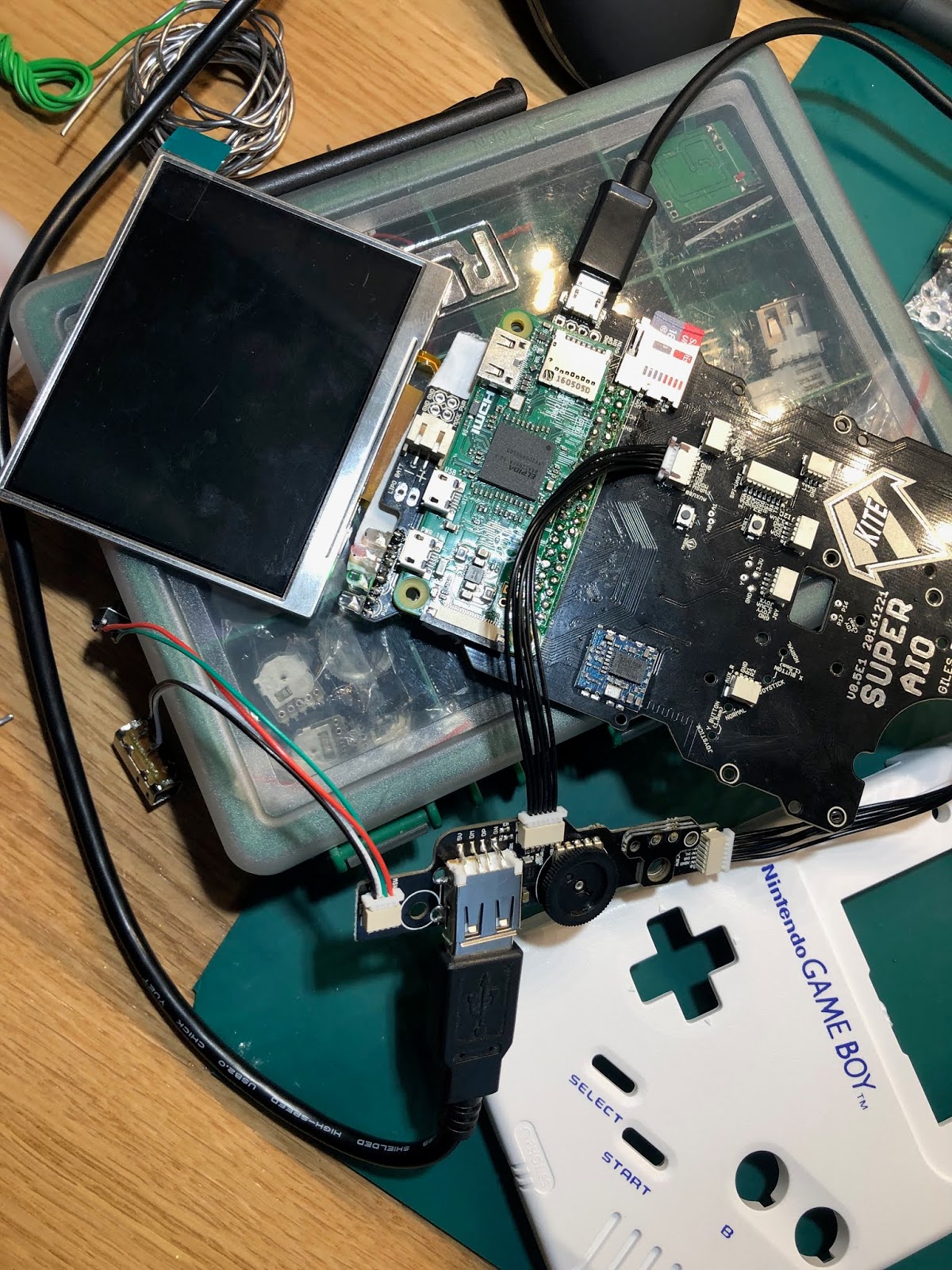
After this I resorted to my usual cathartic activity of building a hand-held games console based around a RasPi and fitted into the dead carcass of an old Gameboy/Gamegear etc. I didn't make any videos of this project (unlike the Gamegear from last year https://youtu.be/Mt1VP-AjSQU);


BUT, back to the most recent build; I was really pleased how it worked out, probably the most tidy one I've done to date. I also implemented a proper shut-down script so the power button doesn't just crash the Pi (and I monitor the LiPo's voltage to avoid the system crashing that way too).


The other thing I took to whilst off was to start learning the Python programming language - if you're looking to get back up to speed with coding Python seems to cover a lot of the principles of modern scripting languages - the thing that has blown me away the most so far is the list data type - a list can have different data types within it! Perhaps all modern languages have this, but my degree in Maths and Programming in the mid-eighties did not prepare me for such things!
Can I recommend Jamie Chan's book "Learn Python in one day and learn it well" - as someone who still has a bit of C and VB experience it has bee good for me.

I have also been catching up on my favourite electronics YouTubers;

https://www.youtube.com/user/rossmanngroup
Louis Rossman - Apple repair guy and the best example of surface-mount rework and diagnostics you'll see.

https://www.youtube.com/user/bigclivedotcom
Big Clive - more focussed on big volts and tearing down badly made power electronics!

https://www.youtube.com/user/greatscottlab
Great Scott! My kind of small project builds with something of a focus on Arduino

https://www.youtube.com/user/FFcossag
A brother broadcast engineer who fixes stuff

https://www.youtube.com/channel/UCDbWmfrwmzn1ZsGgrYRUxoA
The Post Apocalyptic Inventor - motors and generators are the emphasis of his builds

https://www.youtube.com/user/EEVblog
Dave Jones of the eevBlog is a design engineer who seems to know everything about electronics; really engaging style too.

So, not sure how 2019 is going to play out - one thing I have realised is that my plans of giving up all this broadcast engineering nonsense are perhaps closer than I thought; maybe the teaching PGCE is even closer than I thought...

Saturday, June 24, 2017

2nd RetroPi handheld build - the GamegearZero

Recently finished the second Raspberry Pi based handheld games console - this one based around a RasPi3 and a Sega Gamegear.

https://youtu.be/Mt1VP-AjSQU


Friday, February 17, 2017

My GameboyZero - build no. 1

I've been building a little RaspberryPi-in-an-old-Gameboy project for running lots of old console and handheld games. RetroPie is a superb project that unifies all of this and makes it very easy.

See my first video here.


3.5" Analogue Composite LCD 
https://www.amazon.co.uk/gp/product/B0056WJP1M/ref=oh_aui_detailpage_o09_s00?ie=UTF8&psc=1
3w Class D audio amp: 
http://www.ebay.co.uk/itm/111792407939?_trksid=p2060353.m2749.l2649&ssPageName=STRK%3AMEBIDX%3AIT 
SudoMod: 
http://sudomod.com/game-boy-zero-custom-parts-guide-part-1/
Wermy:
https://www.youtube.com/channel/UCRP1Zx7B4b66ZwkB2Ov5pMw 
Great Scott! 
https://www.youtube.com/watch?v=_MtN_s4tVK0&t=4s

Thursday, December 22, 2016

Power supply toroid in Mackie SRM450 PA loudspeakers

A friend brought one of these very common PA powered loudspeakers over to the workshop. An internal T4A mains fuse had blown and when I replaced it and re-powered there was a very loud 50hz hum for a few seconds and the fuse in the power cord blew. I assumed it was the audio path that was making the noise and I assumed that one one the probably faults was a short/open de-coupling capacitor that was letting 50hz through to the audio stage.

I found the schematic at Mackie-SRM450 actspk.zip (although this is for the rev.C of the board, but the PSU appears not to have changed).

So - I made sure both fuses were good and with Dave Jones's words "thou shall always check the rails" in my ears I disconnected the output of the large toroid from the two rectifiers/smoothing caps and tried again. I figured I'd make sure the o/p of the transformer was good (there is some de-coupling on the primary). However I got the same loud 50hz for a couple of seconds and one of the fuses failed. The toroid was also noticeably warmer than it had been! So - checking the DC resistance of the primary side showed it to be less than six ohms (so it was pulling an inrush of at least 40A!).


A quick flail around the web showed that the transformer is a known weak point of this design.

 The real bummer is that the transformer isn't stocked by Mackie (or indeed anyone else) and the folks at Save My Light only do a minimum order (ten pieces) from the Chinese factory that wind them when they have enough orders (and the chap there told me he sells an average of two a year).
So, do I just wait or pay him the thousand quid to have ten made?!

Time to keep my eye on eBay for a hopefully working second hand replacement?

UPDATE 16/01/2017: 

So after lots of flailing around the web and finding a few reclaimed ones for more than £150 I came across AJAudio on eBay (Alex Mathew sales@ajaudio.co.uk was super-helpful) and he sold me one for £99.
Job done.

For info - the failed toroid had around 5 ohms DC impedance across the primary whereas the replacement has 8.5 ohms.

It's been shaking the workshop with loud music all afternoon!

Wednesday, June 22, 2016

USB current draw by HID devices and Amulet Zero Clients

One of the complaints I often get from Amulet users is that they get strange results when using power-hungry USB devices. The prime culprits are Wacom tablets (particularly the Intuos and Bambo series) but today I went to a facility where they were getting intermitent behaviour from the left hand control and shift keys which in Media Composer is a real pain. 
The most common third-party Avid coloured-keycap keyboards are from Logic
They come with a USB hub built in and so you'd expect them to draw a bit more than an HID device, but it's worth looking up what the spec is for USB power draw. This is stolen from Wikipedia;

There are limits on the power a device may draw, stated in terms of a unit load, which is 100 mA, or 150 mA for SuperSpeed devices. There are low-power and high-power devices. Low-power devices may draw at most 1 unit load, and all devices must act as low-power devices when, starting out as, unconfigured. High-power devices draw at least 1 unit load and at most 5 unit loads (500 mA), or 6 unit loads (900 mA) for SuperSpeed devices. A high-powered device must be configured, and may only draw as much power as specified in its configuration.
Or, in summary;

However, flipping the keyboard over gives a different story;


Wow, 1.1A - more than twice what the spec says. However - these keyboards are used the world over and it seems that motherboard USB ports are more than able to power them. I thought I'd get my own reading to see what the current draw was so I stuck one of those USB volts/current monitors in line. The keyboard continued to work but the USB-meter gave me a 0mA reading; it was working the day before, but today, no dice. When I got it back to the workshop I opened it up and discovered the current-shunt resistors was blown away!

 see bottom left on the +Vcc rail - where's the resistor?!

So I conclude that the keyboard is actually pulling a lot more than 1.1A (at least at in-rush).

So, Amulet can supply 2.0A across the USB hub on it's Zero Client with a maximum of an amp on any one port. All much better than the spec but somewhat less than the Logic keyboard is pulling. In the case of power-hungry, non-compliant keyboards and tablets I stick in a powered hub and that normally fixes the problem.

Monday, September 21, 2015

"Physics is the only real science; The rest are just stamp collecting..."

You may know this quote by Ernest Rutherford and although biologists and chemists would maybe argue, all scientific people, when they get down to it, know exactly what he meant. We just happen to have given a different name to the physics of living things or the physics of chemical reactions. It's where pseudo-science (Marxism, homeopathy, NLP, Intelligent Design, horoscopes, etc etc etc.) will always show their true colours by not subscribing to the empirical method and falsifiability.

I can recall my first occasion of being aware of physics; aged seven my Dad and I had just watched "The Dam Busters" on TV and decided to build a model of the Möhne Dam out of Mechano. The final touch was two motor-driven gun-turrets powered off a 4.5v bike-lamp battery. Initially the two small motors span too fast to be convincing but my Dad showed me how rather than having two wires going to each motor we could take just one from the +ve terminal of the battery, connect the -ve terminal to the metalwork and earth the 2nd terminal of the two motors. Now, aside from providing an illustration of how car electrics work the two turrets also span a bit slower and my Dad explained that it was down to the resistance through the joins in the strips of Mechano. I understood voltage and (maybe) current at the time, but resistance to current was new and I realised that there were things going on that I didn't yet understand but I needed to!

Spin forward ten years and I was just starting a degree in physics, the very first lecture I attended had a great illustration of how poor our instinct is for all this stuff. The lecturer put up a graph with size on the X-axis (ranging from the diameter of a hydrogen nucleus to the width of the observable universe - suffice to say it was a logarithmic scale!) and velocity on the Y-axis (stationary all the way up to C - 3 x 10⁸ ms-1, the speed of light - the fastest anything can go; God's speed-limit if you will). He then drew on a box which represented most people's experience;
  • Smallest thing; for most people it's the width of a human hair or similar. I look down a microscope often to inspect fibre optic cable, so maybe for me it's a couple of orders of magnitude smaller; 10-5m
  • Largest thing; maybe all that you can see from a high mountain - 1010m2
  • Slowest thing; me in bed! 
  • Fastest thing; traveling in a modern jet liner - 300 ms-1
When you look at that box on the whole graph you realise how poor our experience is against the whole of creation and how you should perhaps trust the numbers rather than your own intuition.
So, physics is hard from a gut-feeling point of view. I changed degrees at the end of my first year to maths & programming but never lost the love of physics. Here are a few things that have helped me along the way.
So, just to stay with the popular science, I heard a great podcast in the "How to be amazing" series with Brian Greene; if you need a bit of a jump-start with your physics then he's your man!

Monday, November 18, 2013

Oscilloscope watch

The watch for the electronic geek. All the features of a watch combined with an oscilloscope and a waveform generator. I've signed up to fund the Kickstarter project which has reached it's goal - happy days!


Features:

  • Mixed Signal Oscilloscope: Simultaneous sampling of analog and digital signals.
  • Advanced Trigger: Normal / Single / Auto, with rising or falling edge and adjustable trigger level.
  • Meter Mode: Average, Peak to peak and Frequency readout.
  • XY Mode (Plot Lissajous patterns or see the phase difference between two waveforms).
  • Spectrum Analyzer with different windowing options and selectable vertical log.
  • Horizontal and Vertical Cursors with automatic waveform measurements.
  • Arbitrary Waveform Generator with Sweep on all parameters.
  • Display options: Persistence, Different grid options, and more.
  • Curve tracer function
I'm signed up as an International Beta Tester. The Beta Testers will receive a prototype as early as December, and a production unit with all accessories in May. Beta Testers will be expected to be involved with the design and report bugs along the way. Apparently this prototype will initially not work, but will start to work as firmware is developed. The prototype hardware may need changes so you might need to do some soldering. The case will be 3D printed with the current prototype design. Come May 2014 the production units will be available and so I intend to do some video blogging as soon as I receive the prototype and keep with it all the way through to the final version.

Friday, February 08, 2013

Passive low-value audio pads

I've often had to knock up audio attenuators to make music gear (which is typically +4dBu for zero level against 0dBu for broadcast) and my usual m.o. is to approximate everything around a 10k potentiometer; typically 100ohm sending impedance, 10k ohm terminating impedance and an H-network for balanced lines and a T-network for unbalanced. You can find numerous examples online.

So - all credit to my colleague Matt for saying "..no, no - let's do it properly";
So, for a variable 1.5 -> infinite pad you need Z1 and Z2 at 390 ohms and a 5K potentiometer. 

Blow me down, the 5k pots arrive with their wipers at the centre position and all six that I've made so far have been bang on 2dBs at that centre point. It pays to be precise.

Thursday, September 27, 2012

Some interesting domestic electronic fixes

Fridge/Freezer earthing conundrum

I've had my Miele fridge for maybe six years and it's one of those frost-free models; I assume an extractor fan maintains negative pressure inside so that moist air that has entered when you open it gets drawn out. About three years ago (after I'd re-arranged some of the mains in the kitchen) it started icing up every few months like an old-style freezer. Of course it was outside it's warrantee so we lived with it. Around eighteen months ago whilst cleaning behind it I noticed the mains cord had been tugged and the earth was disconnected. Of course I re-ended the cable but since then the freezer has stopped icing up.
I've searched online for a schematic for this model to see if I can figure out what is going on. I'm reluctant to disconnect the earth to prove it, but I'm left wondering (and no other engineer I've mentioned it to can give me an answer) why the anti-frost mechanism didn't work without the safety earth? I stuck the freezer on my trusty Martindale 2100 PAT tester and it was fine; no excessive residual earth current and all isolation good; even at 8A.

When is a micro-switch not a switch?


My Valiant combination boiler has the usual configuration of a butterfly valve that routes hot water to either the taps or the heating pump. There is a micro-switch on the valve such that when you open the hot water tap the boiler is forced on (it's unlikely it was on heating the radiators exactly when you needed to wash your hands). The boiler is fifteen years old and I've replaced that micro-switch two or three times before. Earlier this year it seemed to have gone again yet removing the connections and testing for continuity when the valve opened showed the switch (seemed!) to be working. In the end I admitted defeat and got a heating guy in. He concluded the same as me and he 'phone the Valiant tech support line.

"Replace the micro-switch"

"No, no - it's not the switch, it buzzes out correctly when the valve closes"

"Never mind that, replace the switch"


Because it's a common model of boiler and the micro-switch goes often he had the kit in his van. Sure enough, he replaced the switch and the boiler starting working correctly. I was now beginning to doubt a lifetime of electronics knowledge! I got him the call the helpline back and the chap at the other end explained that it's not just a DC voltage that gets switched but the i2c data link! Yes, I was amazed; I can only assume it's part of a wider control system (maybe common across much more complicated boilers); but if there is any electrical noise or impedance on the switch data doesn't get back to the control board and the boiler CPU doesn't fire up the gas.

XBox 360 and failed DVD drive.

What would imagine would be the part most likely to fail in any kind of consumer device? The mechanical part that has a 50p laser diode AKA the DVD drive. Given that it has two connection - SATA and power it should be a user-serviceable part and given you can buy them from eBay and spare parts suppliers home tinkerers like me should be able to fix their XBoxes. But no, the XBox OS is keyed to the firmware serial number of the drive that is installed at the factory and if it sees another drive it not only refuses to read the disk, but it informs the XBox Live! (why the exclamation?) mothership and your account is banned for being a game-stealing pirate.
In the end you have to get the same model of DVD drive (there have been four revisions over the lifetime of the '360) and swap the board between drives so that your new mechanics have an old firmware. It worked for me. 

Saturday, September 01, 2012

Engineer's Bench - new podcast "Custom Hardware 1: Electronics and Arduino"

Hugh and Phil talk about the need for custom made boxes and panels. They talk about the metalwork as well as circuit details used and wind up with a review of the Arduino platform

Find it on iTunes, vanilla RSS, YouTube or the show notes website.

Thursday, August 18, 2011

Mute the TV automatically!

I've been a fan of ComSkip (a PVR plugin that automatically detects/removes TV adverts from recorded MPEG2 transport streams) and I firmly believe that technology will allow us to 'tame' various media sources - advert blocking in Firefox makes the web a nicer place, for example. Anyway - this is great, what a project;


Monday, June 30, 2008

Passive volume controls

The PDF in the link is a good explanation of passive volume control for audio circuits and how to alter the law of potentiometers.

Thursday, April 17, 2008

Tin Whiskers

Tin whiskers caused the failure of the Galaxy IV satellite in 1998. At frequencies above 6 GHz or in fast digital circuits, tin whiskers can act like miniature antennas, affecting the circuit impedance and causing reflections. In computer disk drives they can break off and cause head crashes or bearing failures. Tin whiskers often cause failures in relays, and have been found upon examination of failed relays in nuclear power facilities. Pacemakers have been recalled due to tin whiskers

Friday, July 13, 2007

Scanimate

Scanimate is an analog computer system that was built by the Computer Image Corporation of Denver, Colorado in the late sixties and early seventies. In all only eight machines were ever produced. It was used on many famous jobs over the years, and many of the people that were involved with its development, operation, and care and feeding have gone on to do significant things in a variety of places all over the world. Dave Seig's website is a real treat and a reminder of how innovative engineers had to be before digital framestores were possible. Many thanks to my old mucker Saul Budd for putting me on to this.
It reminded me of the BBC Anchor caption machine that was an electronic analogue video caption generator. By generating shaped wipes (in much the same way as an analogue vision mixer works by using line and field rate waveforms to create circular, square, etc. shaped wipes) with variable voltage offsets to position them the machine was able to make letter shapes and hence words (and even whole lines of text!). Being an analogue machine it drifted and so the kerning between letters would change and even the size of characters changed over the duration of the programme (requiring the operator to keep his eyes on things!).
Now when I started at the Beeb in the eighties people still commonly referred to electronic caption machines as 'anchor' (the news studios all shared an 'anchor lobby' which at that point is where the Aston 3 operators worked). I never saw a working example but ironically some programmes still used real artwork captions (scanned on Sony DMX3000 cameras).

Sunday, April 15, 2007

My standard recruitment questions for engineers

Video:
A DigiBeta machine has an 8-Field lock switch – why is this an anomaly on such a VTR and what does the switch do?

This question would really sort out the sheep from the goats! This shows if they know anything about PAL and how VTRs lock their servos. If they can give a credible explanation that uses the phrase “vertical interval sub-carrier (VISC)” and they appreciate that the VTR can re-encode the PAL o/p with the same phase of sub-carrier that was used to decode it then give them the job there and then!

Audio:
0dBu = 4PPM = -18dBfs

What do these expressions mean and why is this equation significant?

Do they know anything about audio measurements and how analogue and digital levels relate? If they can explain the terms dBu and dBfs then all the better.
What is the significance of balanced audio and why shouldn’t you plug unbalanced equipment into a balanced distribution?

Kind of important – if they mention “common mode rejection” in relation to balanced audio hire them! If they don’t know about the risks of unbalancing a whole facility then worry!

Networks:
Hub, Switch, Router.

What are the differences and similarities between these gadgets? How would you use each?

The whole world runs on packet switched networks – do they know anything about it?

Electronics:
A line-drive amplifier has a gain of 20dBs on zero level – how big a power supply would such an amp need?

Do they know that 0dBu is 0.773v? Do they know that 20dBs is approx a ten-fold increase in power? If they can do the calculation don’t let them escape!
What is the significance of technical and domestic (“cooking”) mains – why shouldn’t equipment powered by one distribution be connected to equipment powered by the other?

Do they appreciate earth distribution and the danger of putting mains hum over every feed in a facility?

Avid:
On a Unity server what is the difference between ‘Allocation Groups’ and ‘Workspaces’?

Any Unity configuring experience (or more importantly have they taken an interest in an installation they may have had to look after?)
What is a Media Database and why would you ‘trash’ it. What other things might you ‘trash’?

Have they had to provide tech support to editors?

Tuesday, November 16, 2004

Electronics is 100 years old!

On 16th November 1904, John Ambrose Fleming applied for a patent for his new invention: the thermionic diode valve. Quite a nice WikiPedia article here.